7 ‘The Devil Wears Prada’ Trends Due for Their Own Revival
What one Vogue writer wishes she could wear to the office, as inspired by the 2006 film.
Reported by Vogue.
When The Devil Wears Prada premiered in 2006, fashion insiders were skeptical. Elle's then–fashion news director Anne Slowey called Patricia Field's costumes "a caricature of what people who don't work in fashion think fashion people look like." Vogue stayed quiet. The film's sartorial excess—Miranda flinging furs, Andy swiping Chanel from the closet—was never meant to be documentary. It was mythology, magazine life turbocharged for Hollywood, reality dialed up several delicious notches. Field herself had the perfect response: "If they want a documentary, they can watch the History Channel."
Rewatching two decades later, something shifted. I stopped asking whether thigh-high Chanel boots belonged in an office and started wanting to steal every single look. Some trends age into prescience. Others deserve a second life. According to Vogue, here's what should come back.
The Accessories That Made Sense Only Then
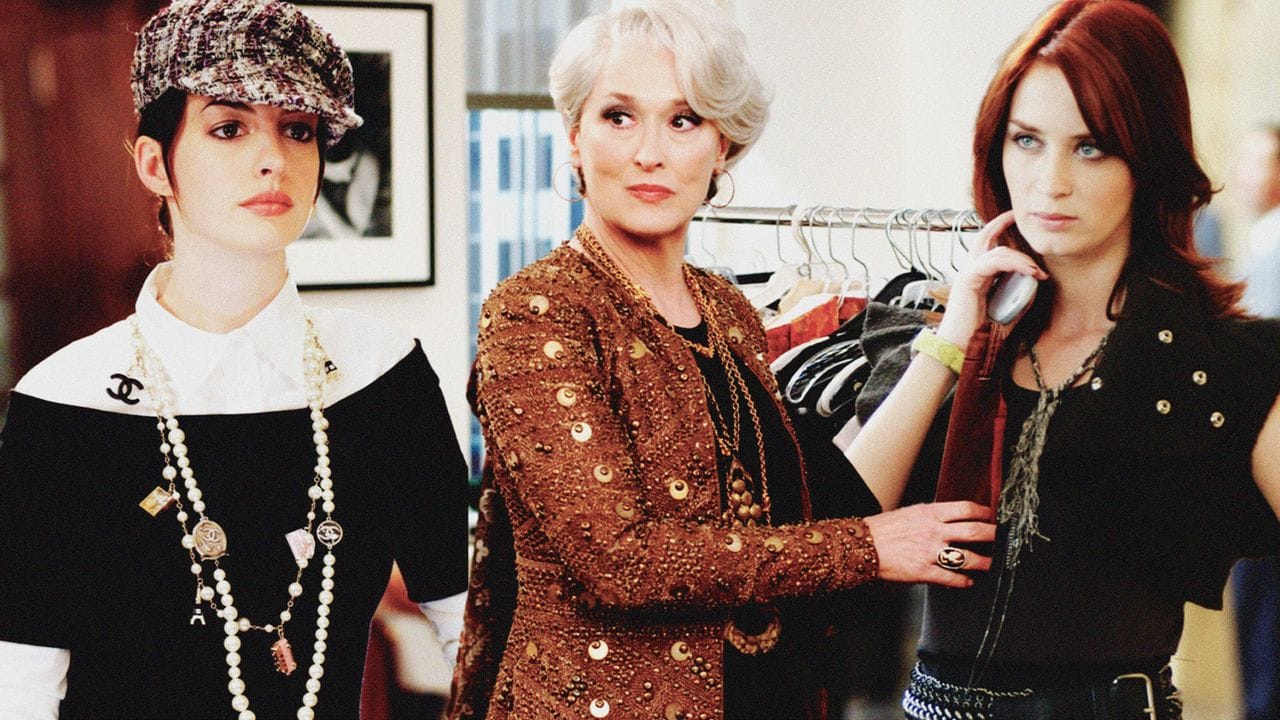
Andy's layered Chanel necklaces—including one from the 2006 Cruise collection dripping with Eiffel Towers and address charms for 31 Rue Cambon—read as pure theater. They're also a prophecy; she wears them in the scene where Miranda offers Paris Fashion Week. Her jewelry knew the answer before she did. After years of quiet luxury so discreet it apologizes for existing, we need jewelry with punchlines again—pieces that look faintly fake, that interrupt rather than whisper. A mid-arm bangle, worn almost as a tourniquet halfway up the forearm, solves an overlooked problem: it won't clang against your keyboard while delivering asymmetric eccentricity. And Karl Lagerfeld's 2005 green knit Fendi Chef bag—slouchy, crochet-bodied, unmistakably early-aughts boho—proves an It bag doesn't need to be pretty. It just needs to make people pause.
Emily Charlton's entrance, armor-plated in a Rick Owens cropped bolero, remains one of costume design's great moments. That bolero exists almost purely to complicate a silhouette, making no practical sense whatsoever—which is exactly why it belongs in a wardrobe built on selective impracticality. Pair it with airy dresses and slim pants, and you've got a silhouette that fiercely edits, to borrow that 2006 critique. Even Andy's unironic Chanel pageboy—worn earnestly with a prim white Yigal Azrouël coat, not ironically with a band tee—suggests that sincerity might be its own form of rebellion.
Then there's Miranda's red fox fur by Izzy Camilleri: a coat worn not for warmth but for entrance, for peacocking, for owning enough sensible jackets to justify one utterly senseless one. It's what excess looks like when it's earned. That's the real lesson The Devil Wears Prada taught us—not how to dress for the job you want, but how to dress for the person you actually are, even if that person occasionally wants to look like a Muppet.
Fashion doesn't need to apologize for being decorative, funny, or unapologetically extra.
Read the original at Vogue.