A Stylish All-Women Wrestling League? Meet Sukeban
In designer fits and makeup by Pat McGrath, the Japanese women’s wrestling league will hold its biggest show in New York
Reported by Harper's Bazaar.
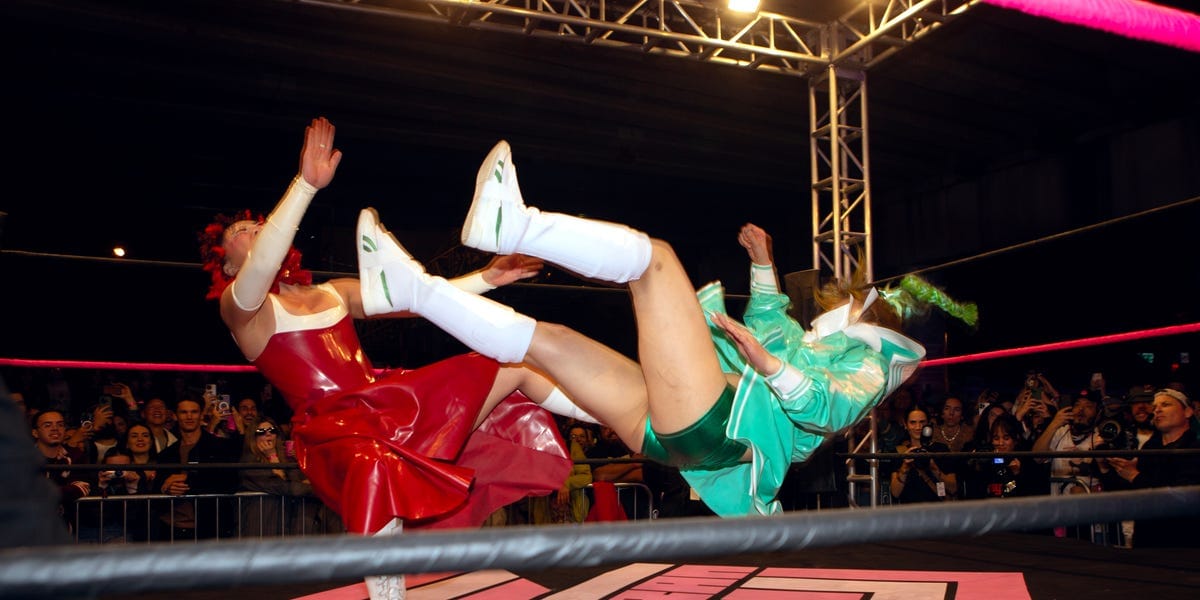
The art world has a short attention span, but the crowd that packed into a Downtown Miami skatepark lot on the opening night of Art Basel 2023 wasn't there for a painting. Nearly 2,000 people — gallerists included — gathered beneath an I-95 overpass to watch women in neon latex outfits throw each other across a wrestling ring. That was the public debut of Sukeban, the all-women's joshi puroresu league that reads less like a sports league and more like a fully realized fashion universe with a body count.
According to Harper's Bazaar, Sukeban was co-founded in 2022 by Parisian designer Olympia Le-Tan, her brother-in-law Alex Detrick, and professional wrestlers Orion Dove and Bull Nakano. The name references the delinquent girl gangs that terrorized Japanese streets in the 1960s and '70s — which tells you everything about the energy. Detrick had been consulting in Japan when he encountered joshi puroresu, a women's wrestling scene that once pulled bigger crowds than the men's league before fading from the spotlight. The ambition: take it global, and make it gorgeous. Le-Tan's entry point was narrative. She borrowed the gang-territory logic of The Warriors and mapped it onto Japanese neighborhoods — Harajuku, Ginza, Shinjuku, Shibuya — each with its own aesthetic DNA. The result is five distinct factions: pastel schoolgirls, goth-inspired femmes in Dangerous Liaisons drag, street-punk vandals with studded jackets, the Cherry Bomb Girls, and the newest crew, Tokyo Toys.
Fashion That Actually Has to Fight
The design constraint is as unforgiving as it sounds: everything has to stretch. Le-Tan landed on latex, then built each look around the individual wrestler's personality — not the other way around. When she met Atomic Banshee of the Vandals, the woman showed up in Vivienne Westwood and talked about punk bands. "Their personalities definitely come first — they are the inspiration," Le-Tan says. For the Hammerstein Ballroom show on May 19, the creative roster is stacked: costumes by Vanna Youngstein and Miss Claire Sullivan (whose tutu for Tokyo Toys' Krackin' Kouki is described as "toy soldier–inspired"), millinery by Stephen Jones, makeup by Pat McGrath's team, nails by Nails by Mei, bags by Katie Hillier, and Nike outfitting several wrestlers for the night.
Sullivan, who has dressed Addison Rae, Rosalía, Lady Gaga, and Doechii, put it plainly: "Tutus are typically seen as delicate and feminine, so there's something really exciting about imagining this garment being worn during a fight." That collision — fragility in the service of force — is exactly what makes Sukeban land. The wrestlers aren't wearing costumes. Crush Yuu of the Cherry Bomb Girls, who decided she wanted to be a wrestler at age nine, says she aspires to be "a cute, stylish, and strong woman who is unapologetically herself." Her teammate Nagisa frames her presentation as "an extension of myself," not a character.
What Sukeban has figured out — and what fashion keeps fumbling — is that spectacle only works when the people wearing the clothes actually mean it.
Read the original at Harper's Bazaar.