After 15 Years, The Eckhaus Latta Obsession is Still Going Strong
The designers behind Eckhaus Latta on their milestone year, their new Mango collaboration, and why trends don
Reported by Harper's Bazaar.
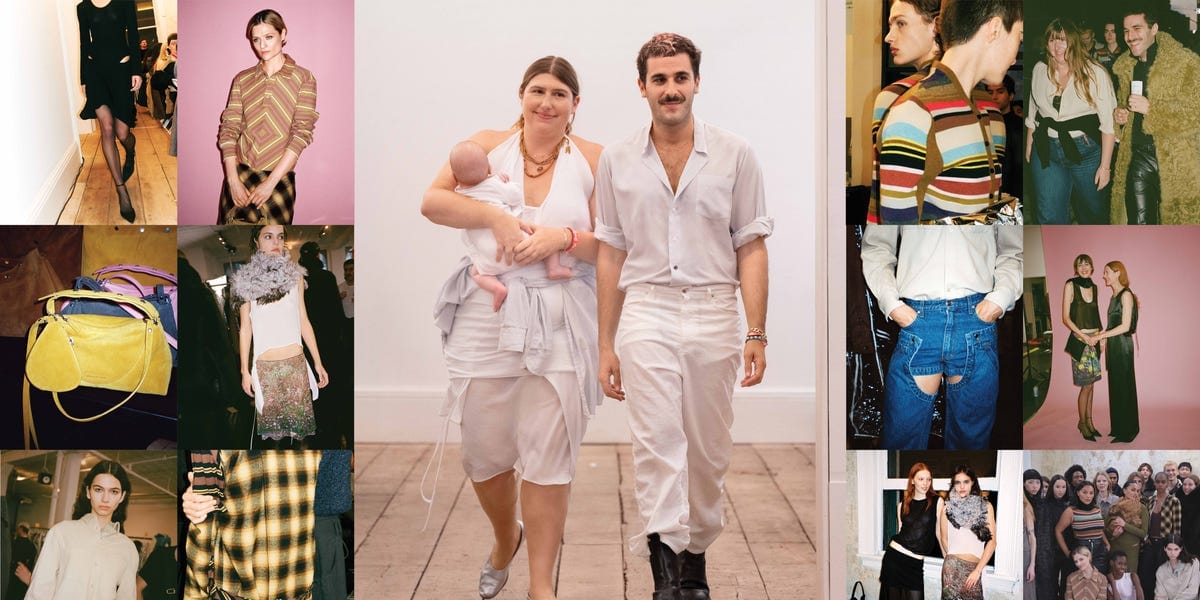
Fifteen years in fashion without selling out, scaling up recklessly, or chasing an algorithm — that's not a business plan, that's a philosophy. Mike Eckhaus and Zoe Latta, both 38, have built one of New York's most quietly radical labels on a deceptively simple premise: make clothes that are provocative without being performative, interesting without being loud. According to Harper's Bazaar, their Fall 2026 collection — a sharp collision of offbeat basics and slashed, sheer eveningwear — was considered one of the best of the season. Fifteen years in, the obsession is entirely justified.
The brand's DNA traces back to Rhode Island School of Design, where Eckhaus (sculpture) and Latta (textile design) met around 2008 and started dissecting the everyday ritual of getting dressed. No formal fashion training. No inherited aesthetic framework. Just a shared curiosity about why we wear what we wear and how clothing can be both functional and quietly transgressive. They moved to New York, logged time at Marc Jacobs, Opening Ceremony, and Proenza Schouler, and in 2011 built their first nine-look collection in three days inside a Brooklyn studio. Retailer Maryam Nassirzadeh — widely regarded as a godmother to New York's independent fashion scene — was the first to stock them and remains one of their most articulate champions. "There is strength in staying consistent," she says. "They love what they do and they don't give up."
Weirder, and Now Bigger
What makes Eckhaus Latta singular isn't just the clothes — though the Goodtime Jeans, with a fly that zips front to back, and a ribbed knit in an intentionally unsettling shade of green, make a convincing argument on their own. It's the entire refusal to perform coolness. Their runway casting isn't casting in any traditional sense; it's a reunion — friends, collaborators, babies on laps. Cast director Rachel Chandler credits the brand's longevity to the authenticity of that ecosystem: "Mike and Zoe have spent 15 years building a brand around their community." Many have tried to replicate the formula. Few have the receipts to prove it worked.
Now, Eckhaus Latta is making moves that feel, on the surface, contradictory — and are actually very smart. A J.Crew Rollneck collaboration sold out in minutes. This June, a full capsule with Mango drops: ready-to-wear, shoes, jewelry, accessories, and swimwear, with pastel metallic jeans, slashed tops, abstract-print bikinis, and ugly-chic red wedge heels that feel distinctly, defiantly them. Latta is not shy about the appeal: "It's going to be in airports. It's going to be in places where we've never sold clothes, and that's thrilling to me." The antiestablishment brand going mass isn't a contradiction — it's the point. Stylist and photographer Thistle Brown puts it cleanly: "If you love it, you're there."
Eckhaus Latta's staying power is proof that the most radical thing an independent brand can do right now is stay exactly, stubbornly itself — and let the audience find its way in.
Read the original at Harper's Bazaar.