Amoako Boafo Drew on Venice’s Rich Creative Heritage for His First Solo Show in Italy
Produced by Gagosian, “Amoako Boafo: It doesn’t have to always make sense” opened this May at the Museo di Palazzo Grimani during the 61st Venice Biennale and is on view through November 22.
Reported by Vogue.
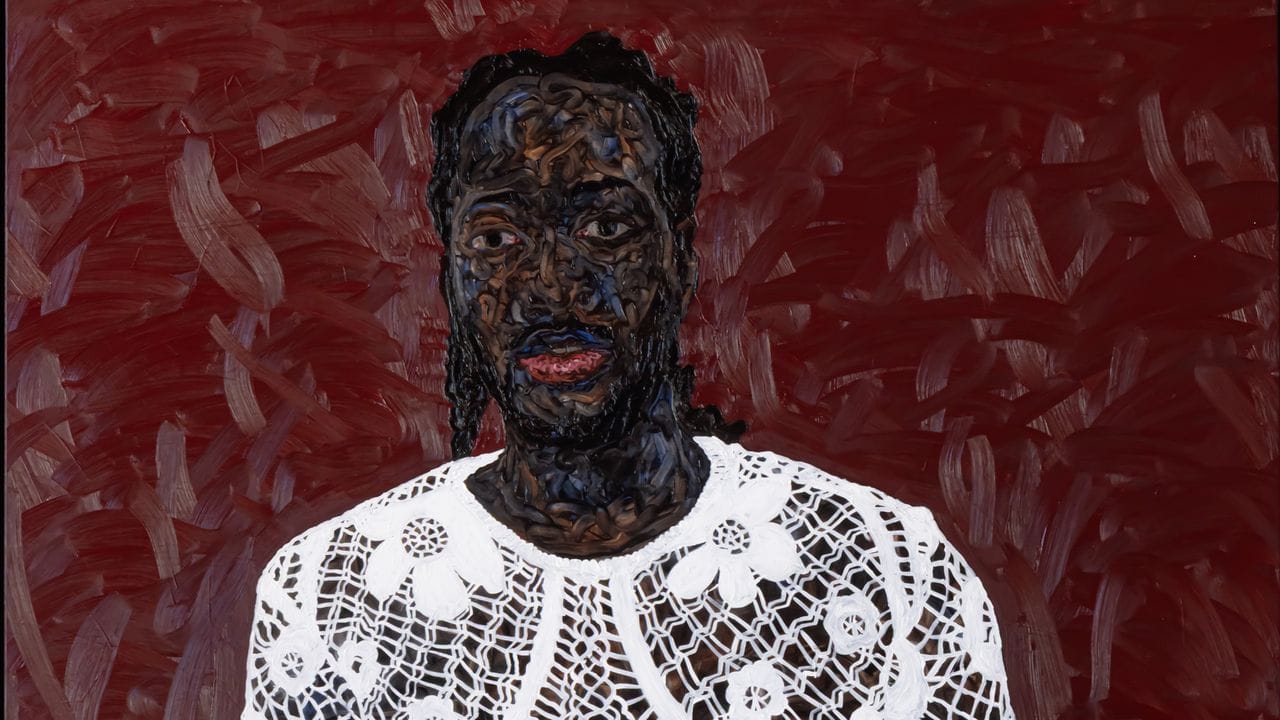
Amoako Boafo doesn't do humility performances. When the Ghanaian artist — known for his finger-painted portraits of stylish Black sitters — brought his first solo Italian show to Venice this May, he wasn't arriving hat in hand to the canon. He was rewriting who belongs in it. "They are not simply guests," he said of his subjects. "They are affirming their own identities."
Produced by Gagosian and on view through November 22, It doesn't have to always make sense is installed inside the Museo di Palazzo Grimani — a Renaissance-era State museum minutes from San Marco, its walls historically hung with portraits of the Grimani family. According to Vogue, Boafo treated the space with deliberate care, drawing on Venetian lace as a central motif: the show opens with the towering Mozzarella White Lace Top (2026), its deep maroon tones bleeding into damask-patterned wallpaper described in the exhibition text as fabric historically worn by Venetian nobility. Two portraits of women in off-the-shoulder turquoise and red lace hang together later in the show — an elegant echo. "Back home, if someone is marking an occasion with an element of luxury, you think of lace," Boafo explained. "It carries presence and respect."
Community as Medium
The most emotionally charged room is what Boafo calls the "heroine wall" — 11 bust-length portraits of women against marigold, representing friends, family, and figures he admires. Among them: Koyo Kouoh, the late Cameroonian-Swiss curator who made history as the first African woman selected to direct the Venice Biennale before her death last year. Poems by Ghanaian poet Raphael Worlasi Langani line the walls; one, Darkness, is paired with Boafo's first black-on-black portrait. A sculpture he made with friend Stephen Allotey — a resin-and-plaster woman in an ivy-leaf-printed bra — sits in conversation with a 2023 painting, both using paper-transfer techniques to layer floral motifs onto clothing. His studio, he said, is not an isolated space. It shows.
The exhibition also marks a formal evolution. For the first time, Boafo incorporates embroidery — threading physical texture directly into the work. In White Swimsuit (2026), a halter strap nearly dissolves into the background in wisps of thread. In Two Faces (2021–25), a child's complexion is rendered entirely in a patchwork of brown threads rather than paint. It's a pointed choice from an artist who built his name on finger-painting skin. "I wanted certain elements to carry their own materiality," he said. Textiles, for Boafo, have always been tied to identity — embroidery is just the next logical language.
Boafo — who also founded Dot Ateliers Ogbojo, a writers' and curators' residency in Ghana, in 2024 — described returning to Venice as an exhibiting artist after first visiting as a student as a "full-circle" moment. The pacing of the show, one or two paintings per room, lets you actually look: terrazzo floors and beamed ceilings frame work that intervenes without apologizing. When Black portraiture walks into a palazzo, it doesn't ask permission — it plants a flag.
Read the original at Vogue.