Betye Saar’s Magic Touch
“Let’s Get It On: The Wearable Art of Betye Saar,” is running at Roberts Projects in Los Angeles from May 30 through August 22, 2026.
Reported by Vogue.
At 98 years old — with her centennial arriving this summer — Betye Saar still stops dead in front of an old photograph and lets out a gasp of pure delight. That's the Betye Saar you need to know about right now.
According to Vogue, the legendary Los Angeles assemblage artist and cornerstone of the West Coast Black Arts movement is being honored with "Let's Get It On: The Wearable Art of Betye Saar," opening May 30 at Roberts Projects in LA. The exhibition — more than 200 objects spanning the 1950s through the 1970s — reframes a chapter of Saar's life that has been quietly overlooked: her years as a costume designer, seamstress, jewelry maker, and creative force-for-hire long before the art world caught up with her. This is not a side story. This is the origin story.
The Studio Was Always Wherever She Stood
Saar grew up in Watts, where childhood walks past Simon Rodia's Watts Towers taught her early that discarded materials could become something monumental. Her mother was a seamstress; her grandmothers painted china and quilted. "If we wanted a new dress, we had to make it," Saar recalls. That Depression-era resourcefulness never left her. After graduating from UCLA in 1949 with a degree in design, she built a creative life through enamelware, handmade jewelry, kitchen-studio printmaking, and Christmas studio sales out of her own home. She wasn't waiting for permission or a gallery — she was making things, constantly, because that was simply how she moved through the world. The assassination of Martin Luther King Jr. in 1968 sharpened that impulse into something politically urgent. "I couldn't walk in protest. But I did have a weapon and that was art," she told LACMA. Within years she produced Black Girl's Window (1969) and The Liberation of Aunt Jemima (1972) — assemblages that remain among the most powerful works in American art history.
But between domesticity and those landmark pieces sat a formative stretch at Los Angeles's Inner City Cultural Center, founded in the wake of the 1965 Watts Rebellion, where Saar joined as an apprentice costume designer through a Ford Foundation initiative and eventually became the company's first costume mistress. Working on shoestring budgets for productions of West Side Story, Burlesque Is Alive, and Antigone, she raided secondhand stores for men's suits, deconstructed fabrics she loved, and rendered costume sketches — feathers, sequins, jewel-toned capes, tasseled bodies — that already looked like collages. By 1972's Antigone, her design renderings were laid against faux wood grain, botanical prints, and textured paper scraps. The assemblage aesthetic wasn't something she arrived at later. She was already living inside it. "I never considered myself an artist," she says of those years. "Always as a designer." The exhibition makes clear that distinction was never as clean as she thought.
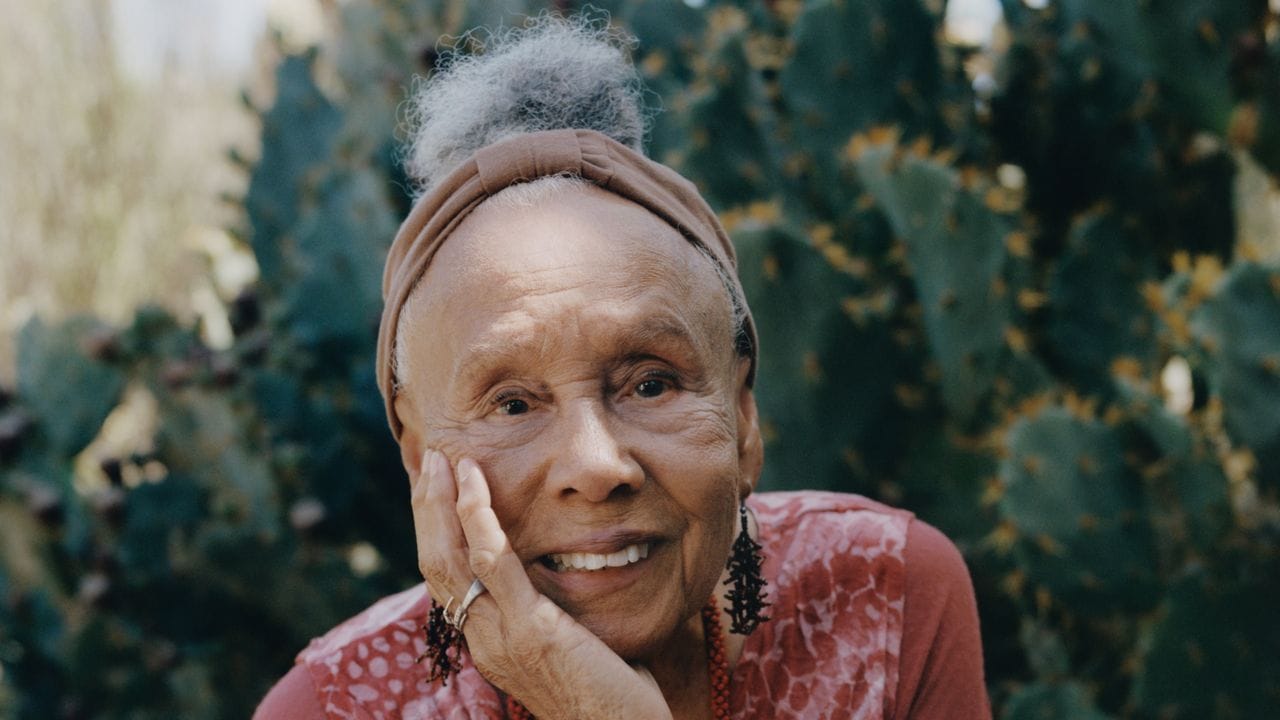
Saar showed up to her own retrospective in pale blue cheetah print — a personal signature — silver hair in a soft knot, fingers layered in decades of flea market finds, and the energy of someone fully present, not nostalgic. She still gardens daily, was photographed for Vogue by Tyler Mitchell amid desert cacti at the Huntington Gardens (and ignored staff warnings about the terrain to get closer to the shot she wanted), and will celebrate her 100th birthday with a second exhibition, "Betye Saar's Black Dolls," at the New York Historical Society later this year.
A century in, Betye Saar is proof that the work was never waiting for the world to recognize it — it was happening all along, in kitchens and costume rooms and secondhand stores, because some artists simply cannot stop making.
Read the original at Vogue.