“I Was Born to Love, Not to Hate”—the Painter Taking Inspiration From “Antigone”
Alexandra Grant is presenting the final works in a decade-long project inspired by the Greek myth
Reported by Harper's Bazaar.
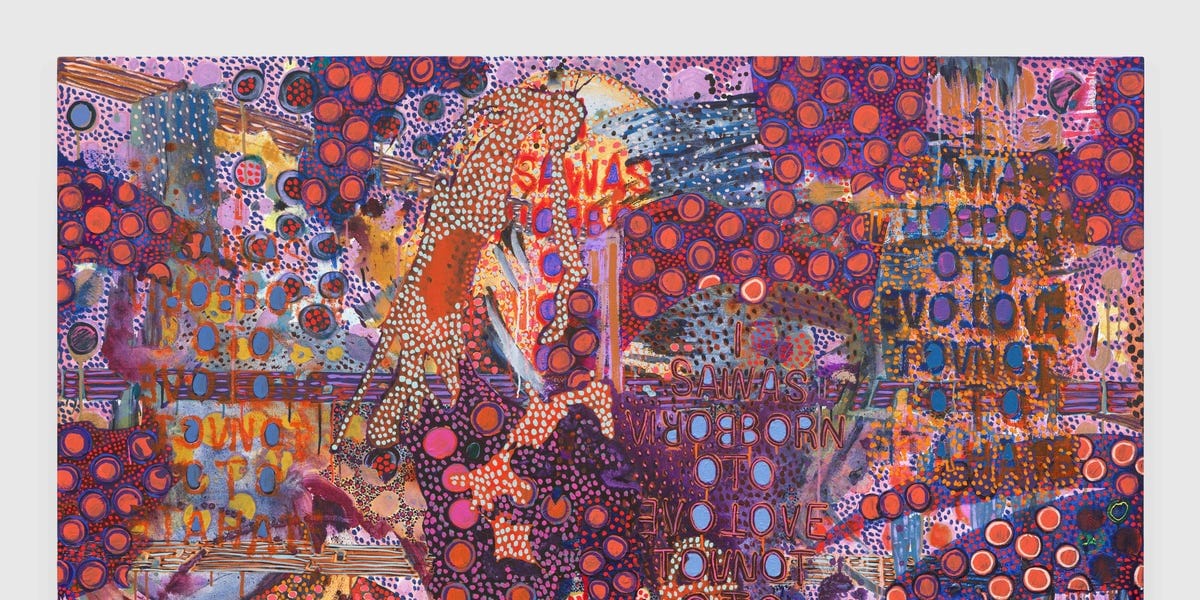
Alexandra Grant has spent the last 12 years in conversation with a dead Greek heroine, and the results are some of the most electrically charged paintings working right now. The Los Angeles-based artist — and, yes, that Alexandra Grant — is closing out her decade-long Antigone 3000 series with a new show, Anakainōsis (Greek for "renewal"), on view at Albert Benda in New York City from May 21 through July 3. According to Harper's Bazaar, the body of work began as a response to the 2014 police killing of Michael Brown, when Grant, like many artists, turned toward Sophocles' myth of mourning and defiance to process collective grief in a country coming apart at the seams.
The anchor of the entire series is a single line pulled from Sophocles: "I was born to love, not to hate." Antigone hurls those words at a tyrannical king who refuses to let her bury her brother — an act of pure, furious resistance. For Grant, 53, the phrase became something more personal over time: a creative lifeline as she navigated her own rising public profile and the relentless "curiosity online" that came with it. She processed all of it — the political upheaval, the scrutiny, the noise — through paint. "I needed the paintings," she has said. "I needed to work through what I was living through."
From Legible to Volcanic
The visual evolution of the series tracks Grant's emotional arc almost literally. Early iterations placed the Sophocles quote on sculptural plaster forms; by 2019, a pivot to silkscreen allowed her to layer the words directly onto sprawling, baroque canvases — still readable, if you looked. The new work goes further. In Volcania (2026), a explosive rush of orange, red, pink, and yellow, the words are almost entirely buried. The text hasn't disappeared so much as dissolved into the energy it once spelled out. Grant calls it a "language of painting" — emotional, illegible, immediate. The question she's sitting with now: what if the mantra works so completely that you no longer need to say it?
Grant's relationship with language in visual art runs deep. She started her career translating poems into sculpture — mobiles she describes as "drawing without paper" — before migrating toward paint, always keeping text as a structural element. The Antigone series mirrors that whole trajectory in miniature: from object to rubbing to silkscreen to pure abstraction. It's a 12-year thesis on how meaning moves through form, and what happens when form finally takes over.
Anakainōsis is Grant's graduation from one state to another — not an ending so much as a transmutation, which is exactly the point. When a mantra does its job, you don't need it anymore.
Read the original at Harper's Bazaar.