Kim Petras on Her High-Voltage New Album ‘Detour’—and Bringing Its World to Life Through Fashion
After leaving her label earlier this year, Petras released her best album yet—and used her own collection of vintage designer fashion to tell its story visually.
Reported by Vogue.
Kim Petras spent a year in label purgatory over an album her team didn't want to release. Detour — a collision of industrial EDM, grunge, and pop — made her label nervous enough to shelve it entirely. So she bought herself out of her contract, footed the bill independently, and dropped it at the end of May on her own terms. According to Vogue, this is someone who has already cycled through bubblegum pop, gothic synth-pop, hyper-sexualized club tracks, and a Grammy-winning Sam Smith collab — and her fanbase has a running joke about how many times she's "debuted." Detour is different. It's the first time she sounds completely like herself.
The album is, even accounting for the chaos behind it, her sharpest work yet. Lead single "Polo" goes full buzzsaw over industry betrayal. "Jeep" is a country-tinged ballad about toxic love and feeling like a foreigner in America. "101" is pure electroclash bravado — think Gwen Stefani's The Sweet Escape but unhinged. And then there's "Brutalist," the gut-punch: an autobiographical track about road-tripping through Germany with her architect father to visit clinics for her gender transition, their shared love of a Brutalist post office, and returning years later to find it demolished. As a metaphor for trans identity, it's devastating in its simplicity. "There were moments where I really worried," she says. "Am I a little bit ashamed to share that much of… just myself?"
The Archive Is the Aesthetic
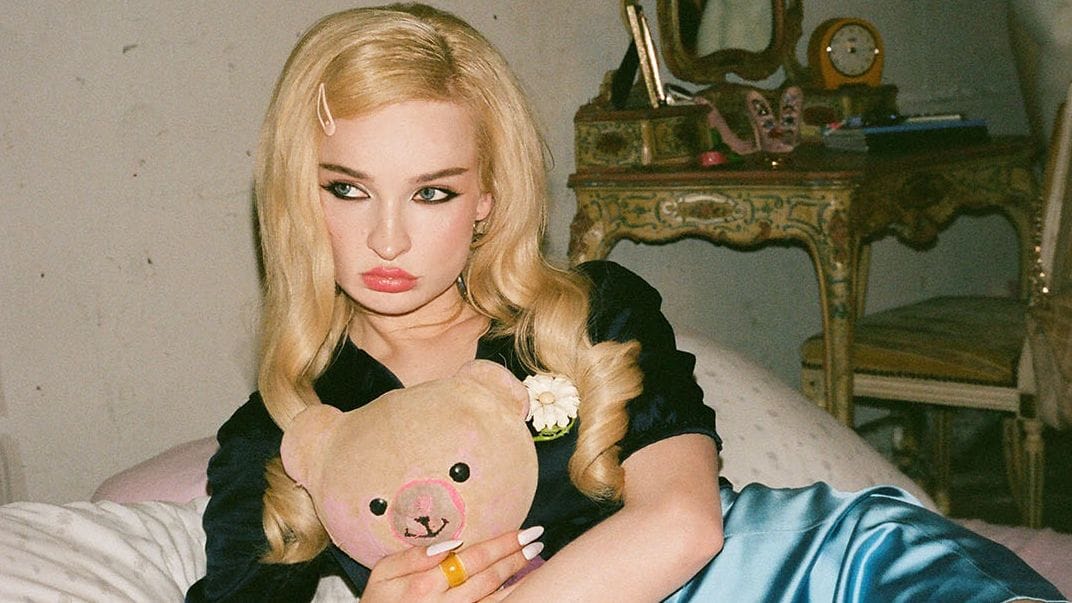
The visual world of Detour is equally intentional — and largely self-styled. Petras has been building a personal fashion archive for years, with a particular obsession over Marc Jacobs's early Louis Vuitton collections: the sugary florals of spring 2007, the Richard Prince nurses of spring 2008. She was streaming runway shows on FashionTV via YouTube as a teenager in Germany. For the album's visuals, almost everything is vintage, sourced from forgotten early-2000s mall brands she's tracked down at Nine Two Five in Downtown L.A. The only new piece she called in was a Dsquared2 denim dress. Her album cover look — a custom set printed with European Union stars — was designed by Irish designer Timothy Gibbons of CFDA-nominated label Gabe Gordon.
It all feeds into the same throughline: a German girl who moved to L.A. with an accent, a work ethic, and a refusal to sand down her edges. She left in mispronunciations. She kept the rawer vocal takes. She made the record at night in secret with underground collaborators — producer Margo XS, hyperpop duo Frost Children, Porches' Aaron Maine — who called themselves "the fellowship of Detour." By day, she was still doing sessions with mainstream producers to appease the label. "We just thought, how do we make something that sounds like the future to us?" she says. "Instead of nostalgia bait."
Her off-duty wardrobe is zip-up hoodies and miniskirts. Her stage persona has historically lived in a different universe. Detour is the project where those two versions of Kim Petras finally close the gap — and the lesson is simple: the best creative work tends to arrive when you stop asking the room for permission.
Read the original at Vogue.