Marilyn Monroe’s Most Famous Dress Is Ready for Its Close-Up
Ahead of the Academy Museum’s new Marilyn Monroe exhibition, a closer look at the iconic “Gentlemen Prefer Blondes” gown—and the mythology stitched into its seams.
Reported by Vogue.
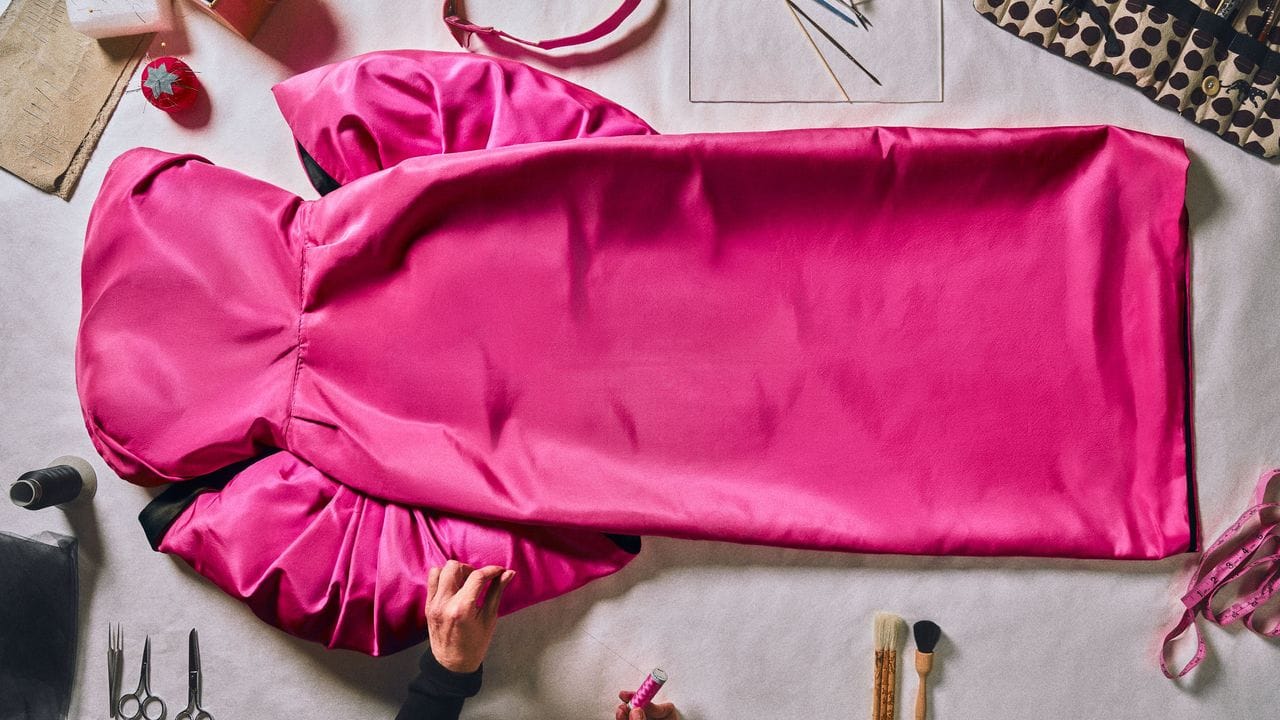
Inside a conservation room at the Academy Museum of Motion Pictures in Los Angeles, William Travilla's shocking-pink creation — the gown Marilyn Monroe wore to sing "Diamonds Are a Girl's Best Friend" in Gentlemen Prefer Blondes — is being examined with the attention of a surgical team. It inspired Madonna's "Material Girl," Ryan Gosling's Ken moment at the 2024 Oscars, and more Halloween costumes than anyone can count. Now it's the centerpiece of "Marilyn Monroe: Hollywood Icon", opening May 31, 2026 at the Academy Museum and running through February 28, 2027 to mark Monroe's centennial.
In person, the dress is weirder and more fragile than the myth allows. The peau d'ange silk is punctuated by a sharp black strip down the back — a noir slash hidden beneath all that candy. What looks like one oversized bow on film is actually an engineered arrangement of folds and pleats. Inside the seams: sweat stains, stress fractures, evidence of frantic workshopping. "The design is brilliant," Academy Museum associate curator Sophia Serrano tells Vogue. "But the actual quality of it is not made to last beyond the filming of that number." The most iconic dress in Hollywood history was, materially speaking, a rush job.
The Scandal That Built the Dress
The original concept for the number was a glittering, burlesque-adjacent showgirl fantasy. Then Monroe's nude calendar photographs resurfaced — images she'd shot years earlier as Norma Jeane for $50 rent money, according to Vogue. Fox panicked. Executives demanded she deny it. She refused. "She said, 'Why would I do that? I did do it,'" recalls Bryan Johns, owner of the dress and co-founder of the Icon Collection. "She owned it." The studio's solution: have Travilla rebuild her image, fast. He had, Johns estimates, maybe two weeks to scrap the original concept entirely and produce something that read wholesome, spectacular, and entirely Marilyn. Serrano says you can see exactly where the pressure shows — the experimental linings, the layers cut and re-cut to control movement, the heat damage from studio lights.
The dress's journey off-set is its own detective story. After production, Fox sold it to collector Michael Shaw — who once owned Dorothy's ruby slippers — for $12, with a pink prototype discarded from the same sequence going for an extra $2. For decades it drifted through collector folklore, rumored damaged or lost. Johns tracked it by obsessively combing auction catalogs until he spotted it in the background of a 1970s documentary about the ruby slippers. By 2010, it surfaced at Profiles in History's Hollywood Auction 40, where an anonymous buyer paid $310,000. Johns eventually located the buyer's family — the collector had since died, and his son barely remembered the purchase — and the family ultimately parted with it.
At the museum, the pink dress will be lit to perform two versions of itself: from the front, Technicolor-saturated and hyper-real; from the back, the actual textile in ordinary light. It's the right call. Monroe, who obsessively reviewed contact sheets, crossed out negatives, and cut up photographs she didn't approve, understood better than anyone that the image and the reality were two separate projects — and that controlling both was the job. The pink dress, in all its hasty, stained, engineered imperfection, is proof she was always the smartest person in the room.
The most enduring thing about Marilyn Monroe isn't the fantasy she sold — it's the precision with which she built it.
Read the original at Vogue.