Rhode Island School of Design Fall 2026 Ready-to-Wear
Rhode Island School of Design Fall 2026 Ready-to-Wear collection, runway looks, beauty, models, and reviews.
Reported by Vogue.
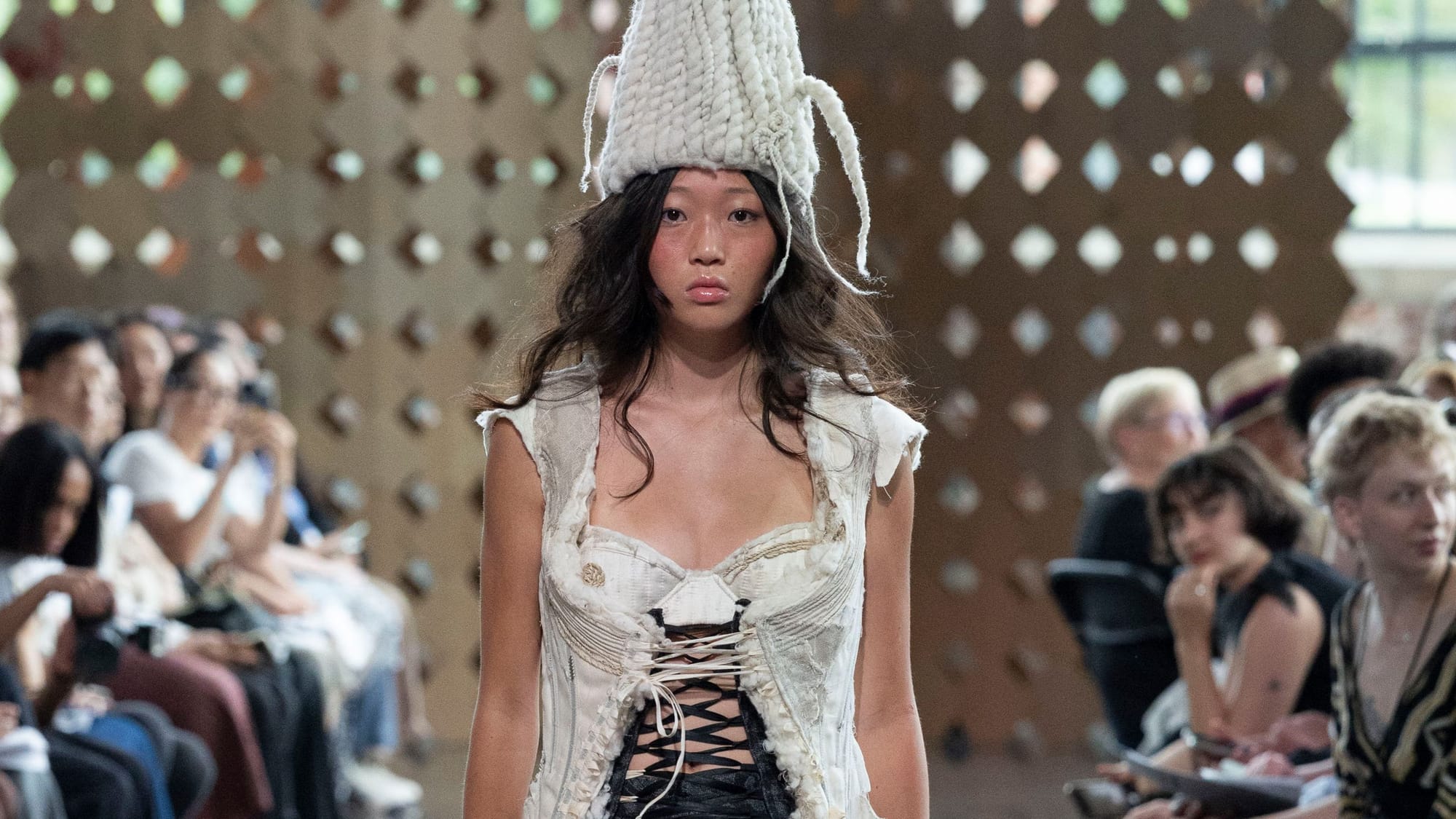
Every spring, the fashion world glances toward Providence, Rhode Island, where RISD's graduating apparel class reliably delivers something the industry's trend cycle can't manufacture: actual conviction. The class of 2026 is no different. According to Vogue, department head Gwen Van Den Eijnde described the twelve graduates as "eclectic" — a word that undersells how seriously these designers are thinking about what clothes can do and say and resist. What unified them wasn't an aesthetic but an obsession: material. Yoga mats, wasps' nests, sugar sacks, discarded wedding gowns, burlap coffee bags. Van Den Eijnde noted that deep engagement with hand processes and textile transformation functions as a kind of "resistance against artificial intelligence" — which, in 2026, feels less like a philosophy and more like a manifesto.
Two of the collection's most urgent voices were Azaria Van Der Stok-Smallwood and Paige Sias, both Virgil Abloh "Post-Modern" Scholars, both centering their work on their experiences as Black women. Van Der Stok-Smallwood built dramatic silhouettes from oyster shells and hand-collected reeds, thousands of raffia-like fabric strips generating regal volume and the kind of slow, undulating movement that earns her own declaration: "Dress becomes my site of liberation and resistance." Sias pulled from her family's history with sugar cane labor, applying intensive craftsmanship to deliberately humble materials — denim corseted into structure, a cotton sugar sack cut into a coat, burlap coffee bags transformed into a minidress, wedding gown scraps pieced into an openwork dress that glittered like both inheritance and defiance. Nerukessa Burgess, a trans Jamaican-American designer, looked outward rather than inward, referencing Jamaica's Olympic uniforms and flag in a collection described as "a fusion of drag and beach culture."
Where the Experimental Gets Physical
Zoe Goldemberg — who interned with downtown New York iconoclasts ThreeASFOUR — submitted perhaps the collection most willing to break fashion's own rules. A knit one-piece was veined with hydraulic tubing carrying purple-tinted water, functioning as a wearable circulatory cooling system. Another construction, built from yoga mat strips tied with uninflated balloons, prompted Van Den Eijnde to invoke Buckminster Fuller. Elsewhere, Micaela Giulianelli sent models out with chiffon obscuring their faces, heat-pressing trash bags onto fabric to create a skeletal, organic surface that read simultaneously as wound and armor. Her thesis negotiated femininity against the need for bodily protection. "The beauty and the menace are inseparable," she wrote — and you believe her. Liam St.Clair-Round designed for beings beyond this planet using copper foil and tape; Mariam Devadze built a jacket upside-down and adorned it with nuts and bolts, then built a coat around a garment bag with a plaid shirt visible through its clear front. Structure, she wrote, is where she hunts for poetry.
The class's more tender moments were no less rigorous. Day Koo spent 90 hours constructing a single ivory coat from open-weave linen strips, her silhouettes shaped by grief and love for her grandmother — old photographs translated into dye techniques that mimicked how memory fades and stains. Ellia Baldwin pressed locally collected wasp nests under tulle on a jacket cast directly from a live model and aged another garment through smoking. Cali Kircher treated supper's leftovers — eggshells, wax paper — as accessories, exposing her construction stitches in red as a kind of love letter to process and childhood wonder. And Ji Hu Park, unbothered by irony, showed bubble skirts and pin-tucked heart bodices under the straightforward conviction that "everything should be prettier, everything should be brighter." In a graduating class this unafraid, even optimism functions as a statement.
What the RISD class of 2026 makes clear is that the most radical thing a young designer can do right now is slow down, get their hands dirty, and mean something.
Read the original at Vogue.