<strong>You Can Create a Dress With Iris van Herpen as Part of Her Brooklyn Museum Show</strong>
Sculpting the Senses presents jaw-dropping garments and objects, as well as a chance to try your hand at pleating alongside the Dutch designer
Reported by Harper's Bazaar.
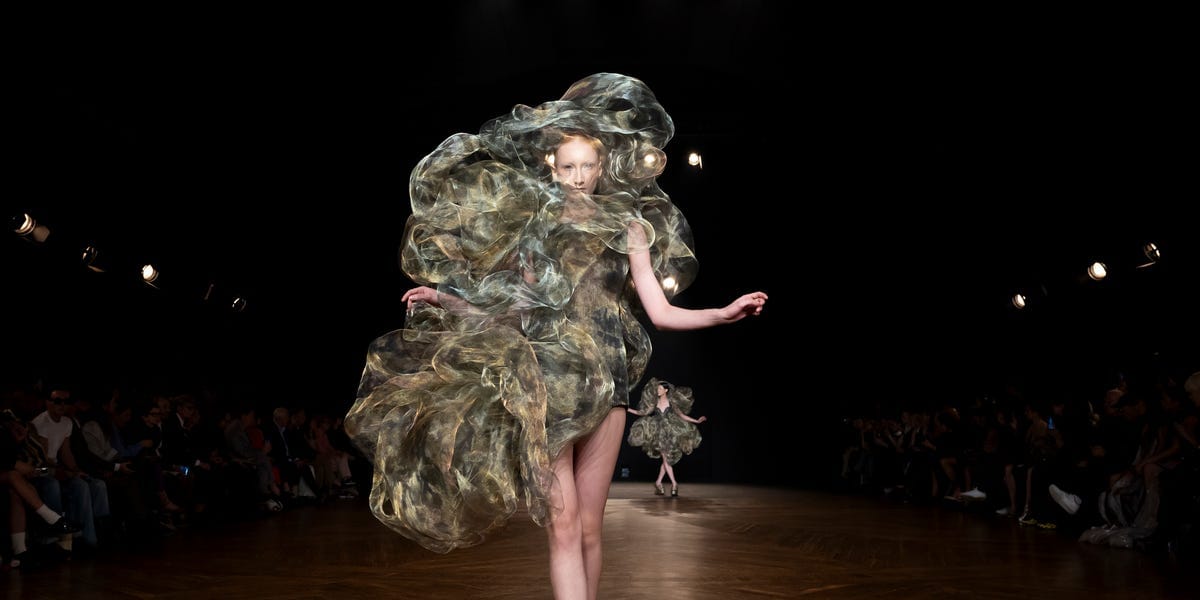
Iris van Herpen once argued with her design school professor that she'd never need Illustrator or Photoshop. She was studying historical haute-couture techniques at Arnhem's ArtEZ Institute of the Arts, grew up without a television, got her first phone at 19, and her first laptop at 22. Today, nearly two decades after founding her label, she's the designer who debuted the first 3D-printed runway dress and built a gown that releases bubbles via hidden microprocessors. The irony isn't lost on her.
The North American debut of Iris van Herpen: Sculpting the Senses opens this May at the Brooklyn Museum — the largest iteration yet of a retrospective that has already traveled through Paris, Australia, Singapore, and the Netherlands. According to Harper's Bazaar, the exhibition brings together more than 140 haute couture looks alongside fine art, decorative objects, and natural history specimens, organized by senior curator Matthew Yokobosky and curatorial assistant Imani Williford. On view through December 6, 2026, it includes new additions: the otherworldly "Living Algae" look, co-created with biodesigner Chris Bellamy, which houses 125 million bioluminescent algae that emit light in response to movement, and the fiery gown van Herpen made for Anne Hathaway in Mother Mary — depicted as a one-night creation onscreen, but in reality a three-month, multi-person undertaking.
The Most Intimate Room in the Show Is 72 Feet High
The Brooklyn Museum's Rotunda gallery has been transformed into a replica of van Herpen's Amsterdam atelier, where hours of footage showing three distinct handcrafted techniques plays across 25-foot fabric panels draped on mannequins. Also debuting here: Weightlessness of the Unknown, a 2024 aerial sculpture van Herpen describes as a self-portrait of her inner world. It serves as the backdrop for the show's most unexpected offering — a 20-minute, one-on-one session with the designer herself, on select days, where visitors fold a custom metal-based fabric using a plissé technique that has become a house signature. Because the pleating is calibrated to the width of each person's finger, every piece is distinct. "Like handwriting," she says.
Van Herpen is also documenting each conversation that unfolds during these sessions. After the exhibition closes, she'll construct a dress whose lining is embroidered with fragments from those exchanges — part time capsule, part collaborative artwork, destined to travel with future editions of the show. "I wanted visitors to experience real couture handwork and the meditative state that comes with it," she explains. "I think we all have that creativity within us, and it just starts with our hands."
In an era when fashion increasingly performs accessibility without delivering it, van Herpen is building something rarer: an exhibition where touching the work, contributing to it, and leaving a trace inside it is the whole point.
Read the original at Harper's Bazaar.