Tennis Champion Aryna Sabalenka Doesn’t Let Up | Vogue’s May 2026 Digital Cover Story
“It’s not okay to be okay with losing,” says tennis’s world number one.
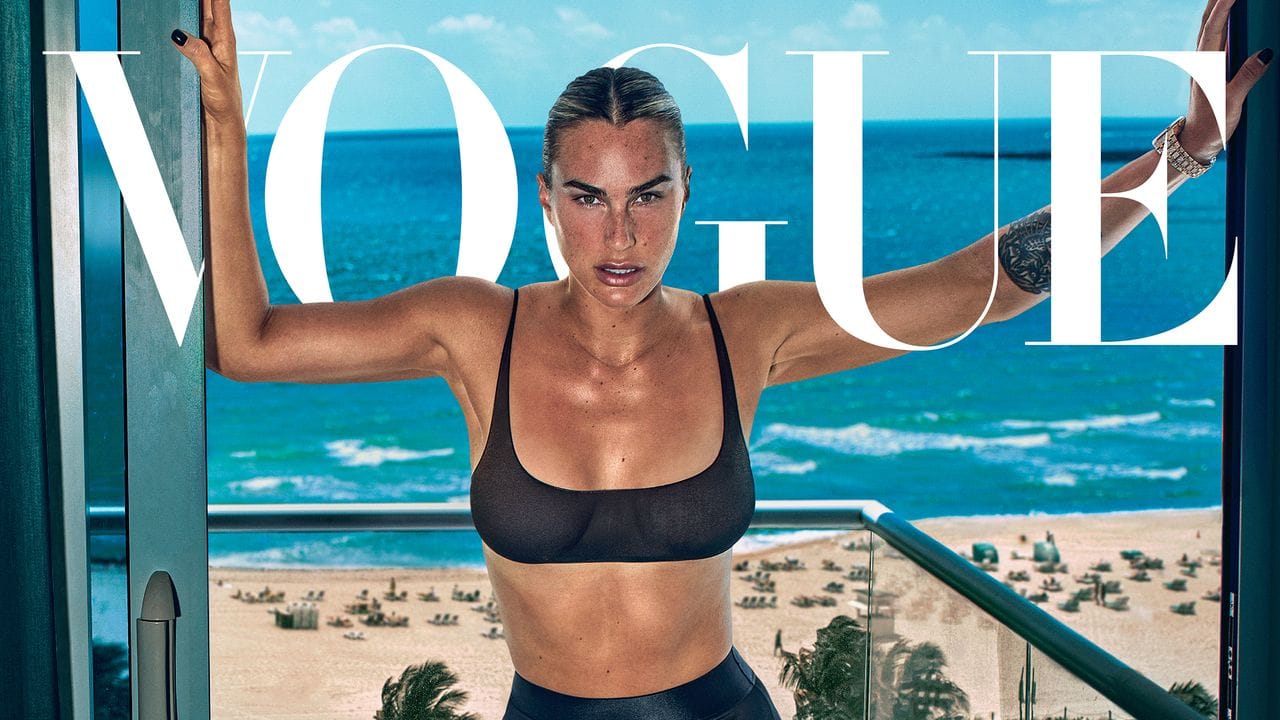
Reported by Vogue.
There is a version of Aryna Sabalenka that the sports world spent years waiting to implode — the one who smashed rackets, screamed at officials, and handed away leads she had no business losing. That version still shows up occasionally. What's changed is that she's stopped pretending otherwise, and started winning anyway.
According to Vogue, the world's number-one women's tennis player swept the so-called Sunshine Double this spring — back-to-back titles at Indian Wells and Miami — while simultaneously getting engaged to Greek Brazilian businessman Georgios Frangulis (founder of acai chain Oakberry, with 800-plus locations across 50 countries) and adopting a King Charles spaniel puppy named Ash, after Arthur Ashe. The ring: a 12-carat oval diamond designed by Frangulis and executed by Miami jeweler Isabela Grutman. She called it the best month of her life on live television. Then April arrived, and she dropped a match in Madrid after squandering six match points against 32nd-ranked American Hailey Baptiste. She dreamed about every one of those lost points. She said so out loud.
The Whole Performance
That willingness to be fully, embarrassingly human is exactly the thing that separates Sabalenka from her predecessor at number one, Iga Swiatek — technically brilliant, emotionally opaque. Sabalenka understands, seemingly by instinct, that tennis can be opera. Grunts that prompted umpires to cite her for hindering play. A racket hurled at the Wuhan Open that nearly struck a ball kid. A "shut up!" aimed at a heckler mid-final in Miami, which earned her an obscenity warning moments before she won the trophy. The crowd has always responded — sometimes with adoration, sometimes not — but they have never looked away. She has won four Grand Slam finals. She has also lost four Grand Slam finals. She worked with a psychologist from 18 to 24 and describes the experience as transformative, yet still considers herself a work in progress. The self-awareness is not a PR maneuver. It's just accurate.
Her origin story is less gilded than the diamonds currently stacked on her fingers. She grew up in Belarus, where there was no state-sponsored tennis infrastructure, and coaches repeatedly told her she was "stupid" and would never crack the top 100. A Belarusian businessman named Alexander Shakutin — later sanctioned by the EU for ties to President Lukashenko — provided early financial backing when no one else did. She remains grateful for it, without pretending the complexity away. Her father, who struggled financially when she was young and died before her Grand Slam breakthrough, modeled the kind of resilience she now embodies on court. She nearly quit at nine years old. She stayed because she saw how proud he looked.
The Big Babe era of women's tennis — power players like the Williams sisters, Lindsay Davenport, Mary Pierce — had gone quiet before Sabalenka arrived at six feet tall with ground strokes that redefined force on the women's tour. She brought it back, louder and less polished and more compelling for it. Being ranked number one for all 52 weeks of 2025 didn't smooth her out. It just gave the intensity a bigger stage.
The woman who once lost matches by sheer force of her own emotion is now the most watchable player in the sport precisely because she hasn't fully resolved that contradiction — she's just learned to compete inside it.
Read the original at Vogue.