The Tiki Bar Renaissance Has Arrived
Here’s why tropical-themed bars and cocktails are entering a new (and improved) golden age.
Reported by Vogue.
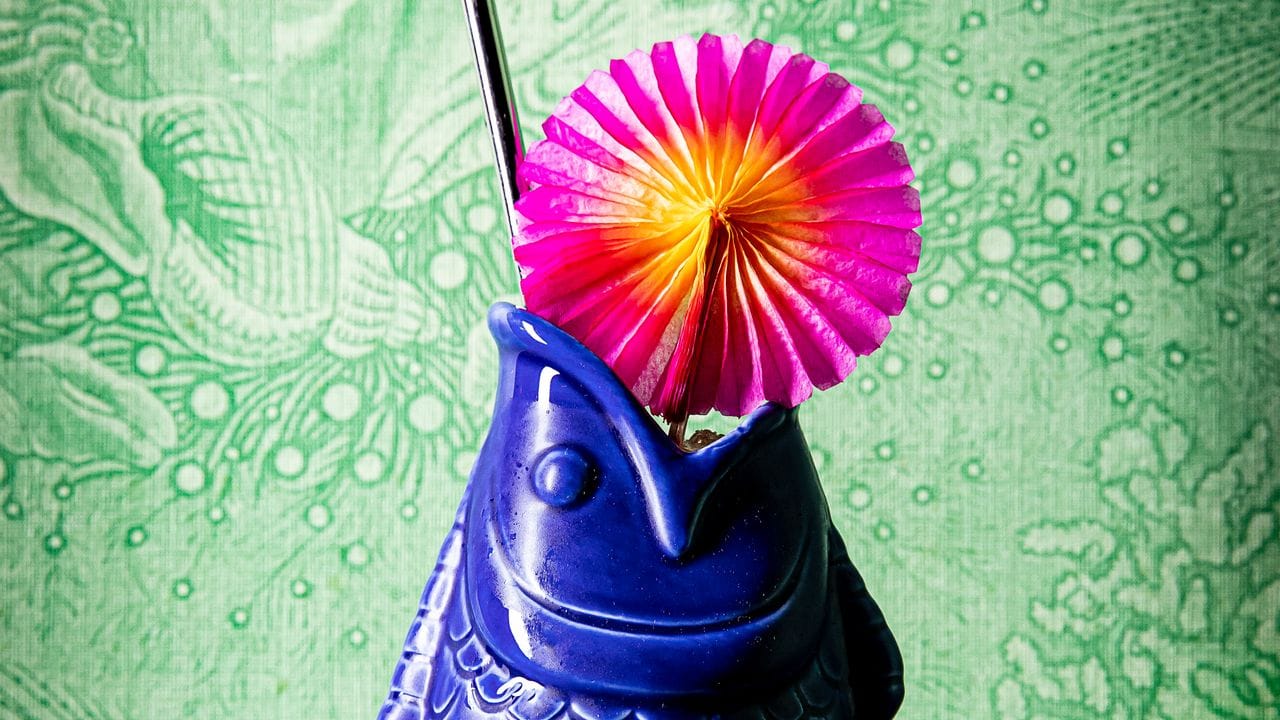
There's a moment at Sunken Harbor Club — tucked above a 19th-century chophouse in Downtown Brooklyn, surrounded by taxidermy fish and flickering lanterns — where a voice crackles over a loudspeaker instructing you to "secure your own cocktails before helping others." The room smells like rhum and salt air. It feels like a fever dream, and that is entirely the point. Tiki is back, and this time it's earning its place at the table.
The genre has always had a reputation problem. Syrupy drinks, plastic garnishes, the uncomfortable cultural cosplay of it all. Fair. But according to Vogue, tiki's origins are richer — and stranger — than the airport-bar Mai Tai would suggest. It started with one man: Donn Beach, born Ernest Gantt, who opened Don the Beachcomber in Hollywood just as Prohibition ended, having spent his youth rum-running through the South Seas and Caribbean. His bars were immersive theater — tin roofs rigged with hoses to fake rainstorms, cocktails served in hollowed coconuts, recipes so jealously guarded they were encoded to prevent theft. Charlie Chaplin drank there. Marlene Dietrich drank there. The whole thing was, by any measure, a sensation. A post-war Polynesian Pop wave and Hawaiian statehood in 1959 sent tiki into overdrive — until the Vietnam era forced a reckoning with exactly what kind of escapism America was selling, and the movement collapsed under the weight of its own artifice.
The Revival Has Receipts
The resurrection began quietly, in libraries and used bookstores. Jeff "Beachbum" Berry spent the '90s and 2000s doing what he calls archaeological work — hunting vintage recipe guides, decoding bartenders' shorthand, reverse-engineering drinks with his wife Annene. He published six books, eventually coaxing old-timers to share their secret recipe booklets, and opened Latitude 29 in New Orleans, now a pilgrimage site for the devoted. His findings reshaped what the modern tiki bar could be: complex, layered cocktails built on fresh juices, house-made syrups, and unexpected spice — Martinique rhum alongside wormwood amaro and falernum, or gin, mezcal, and pisco nudging rum off its solo pedestal. "Contemporary neo-tiki bars use different base spirits to keep up with modern tastes," Berry explains. The drinks stopped being a joke the moment they started demanding to be taken seriously.
What sustains the obsession, though, is the experience architecture. Garret Richard, chief cocktail officer at Sunken Harbor Club and co-author of Tropical Standard, describes the ideal tiki bar as "walking onto a movie set." Alex Lamb, director of the documentary The Donn of Tiki, draws a direct line from Beach's original vision to today's bars designed like crashed spaceships and pirate ships: the goal was never just the drink — it was full sensory departure. Martin Cate of Smuggler's Cove, named one of the World's 50 Best Bars, puts it simply: Donn Beach was selling transportation, not cocktails. A century later, that craving hasn't dimmed.
The iconography is being interrogated alongside the ice program — the colonial roots of tiki aren't being glossed over, they're being reckoned with as the genre reinvents its visual language — but the drink in your hand, built with the same obsessive craft as any fine-dining tasting menu, makes a compelling argument that something genuinely worthwhile survived the wreckage.
Tiki's second act isn't nostalgia — it's a correction, and the cocktails are finally good enough to justify the mythology.
Read the original at Vogue.