This Is What the Met Gala Looked Like in 2016
From Taylor Swift’s “bleachella” hair to debut appearances from stars like Kylie Jenner, it was a watershed year
Reported by Harper's Bazaar.
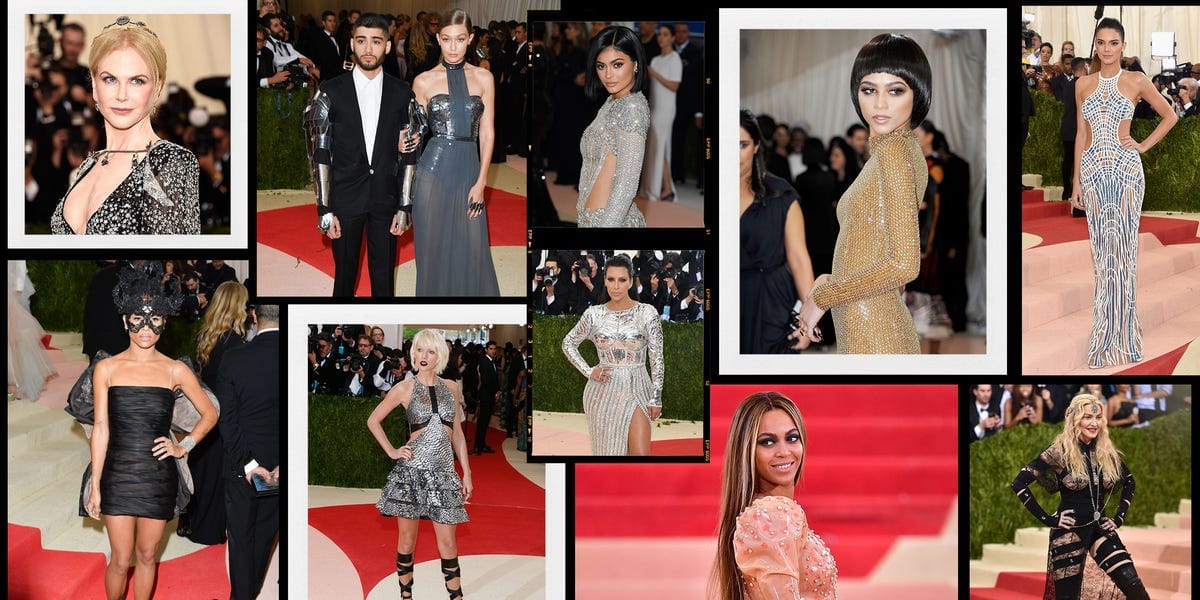
The 2016 Met Gala was a masterclass in literalism. The theme was "Manus x Machina: Fashion in an Age of Technology"—a deliberate nod to the tension between handmade haute couture and mass-produced ready-to-wear. Designers leaned hard into the conceit. Silver dominated the carpet. Sequins mimicked circuit boards. Embroidery became motherboards. It was the kind of thematic year where you could read a look's reference sheet without squinting, when fashion still felt like it had something to prove about its relationship with innovation.
The timing was curious. This was pre-AI panic, yet a moment when tech was already reshaping daily life at warp speed. Apple had just released AirPods. Alexa and Google Home were becoming furniture. VR was on the horizon. The Met's curators understood something crucial: fashion exists in conversation with the world around it, even when that world feels uncertain. In 2016, political upheaval was mounting. Nostalgia was everywhere. But on that red carpet, the mood was forward-facing, mechanical, polished.
The Attendees Who Mattered
What made 2016 significant wasn't just the theme—it was who showed up. Kylie Jenner, the Haim sisters, Demi Lovato, and Idris Elba made their debuts alongside regulars like Madonna, the Olsens, and Sarah Jessica Parker. Gigi Hadid and Zayn Malik walked their first red carpet together that night. And somewhere in the mix, Taylor Swift met Joe Alwyn, a connection that would define her personal life for the next six years. The Met Gala has always functioned as a cultural mirror and a launching pad simultaneously, according to Harper's Bazaar. In 2016, it felt especially potent—a night when celebrity hierarchies were being redrawn and new faces were claiming their place in the ecosystem.
Looking back, the 2016 Met Gala reads as a strange artifact of a very specific moment: optimistic about technology, confident in fashion's ability to decode it, populated by a generation of stars who would go on to define the next decade. The silver, the circuits, the debuts—they all meant something. The event proved that theme nights work best when designers actually commit to the idea rather than simply wearing silver and calling it a day.
Read the original at Harper's Bazaar.