Unsure What the Future Holds? Maybe That’s OK
A new book makes the case for embracing uncertainty
Reported by Harper's Bazaar.
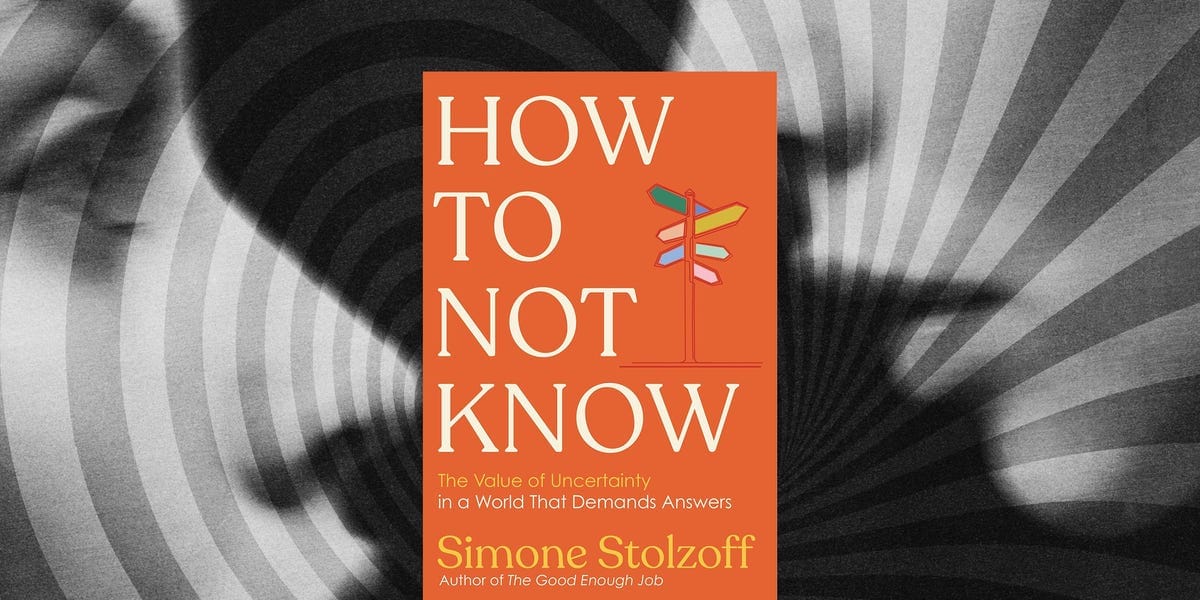
There is a specific kind of spiral that happens when the news is bad and the future is murky and you are, say, sitting in a piano teacher's waiting room frantically texting your husband about nursing school as though you might personally solve the future of work in twenty minutes. Author Simone Stolzoff knows this spiral well. His new book, How to Not Know: The Value of Uncertainty in a World That Demands Answers, makes the case that our frantic lunge toward certainty is exactly what's making us worse at handling its absence — and that learning to sit with the unknown is, right now, the most valuable skill you can develop.
According to Harper's Bazaar, Stolzoff identifies three "certainty traps" that keep us stuck: comfort (grabbing any answer just to stop the discomfort), hubris (bulldozing past doubt because doubt is terrifying), and control (the delusion that if you just think hard enough, a right answer will materialize). The book grew out of his own experience at 28, paralyzed between a New York magazine job and a San Francisco design-firm offer — a decision that sent him canvassing friends, family, his yoga teacher, and at least one Uber driver for answers. What he eventually understood was that he wasn't really choosing between two jobs. He was choosing between two versions of himself, a realization that later became the engine for his first book, The Good Enough Job.
Why Uncertainty Hits Harder Now
A University College London study published in Nature found that uncertainty causes more stress than pain itself — participants who faced a 50 percent chance of an electric shock were significantly more anxious than those guaranteed to receive one. Meanwhile, the Economic Policy Uncertainty Index records its five highest readings in the past five years alone. Add to that the erosion of stabilizing forces — organized religion, defined-benefit pensions, tight-knit community structures — and you have a culture that is both more destabilized and less equipped to cope. Stolzoff points directly at the internet and AI chatbots for warping our expectations: we now operate as though every question deserves a GoogleAble answer, even the ones — Who should I marry? Should I move? What is my career actually for? — that have never had clean resolutions.
The good news is that uncertainty tolerance functions like a muscle, and Stolzoff offers two concrete ways to build it. First, look backward: revisit moments in your own history where you survived not-knowing, and let that become evidence of your own resilience. Clinical psychologist Emily Anhalt frames it cleanly — trust your future self to handle future problems. Second, expose yourself to small doses of the unknown deliberately. Anxiety researcher Michel Dugas's work shows that micro-acts of uncertainty — a new route home, a conversation with a stranger, a restaurant with no reviews — can genuinely rewire your brain's threat response over time. For the decisions that still feel paralyzing, former professional poker player Annie Duke offers two sharp tools: the Only Option Test (if this were your sole choice, would you be okay with it?) and the Happiness Test (will this outcome affect your mood in 10 minutes, 10 days, or 10 years?). Considering the average person burns 250–275 hours a year in analysis paralysis, the calibration is worth it.
In a media landscape glutted with influencers selling five-step certainty frameworks and listicles promising the one right answer to questions that don't have one, Stolzoff's argument is almost radical in its simplicity: not knowing isn't a failure of preparation — it's just reality, and the sooner you make peace with that, the clearer everything else gets.
Read the original at Harper's Bazaar.