What Did the Met Gala Look Like Before Social Media?
Glimpses of the event from photographers, designers, and personalities who attended in the ‘80s, ‘90s, and early 2000s
Reported by Harper's Bazaar.
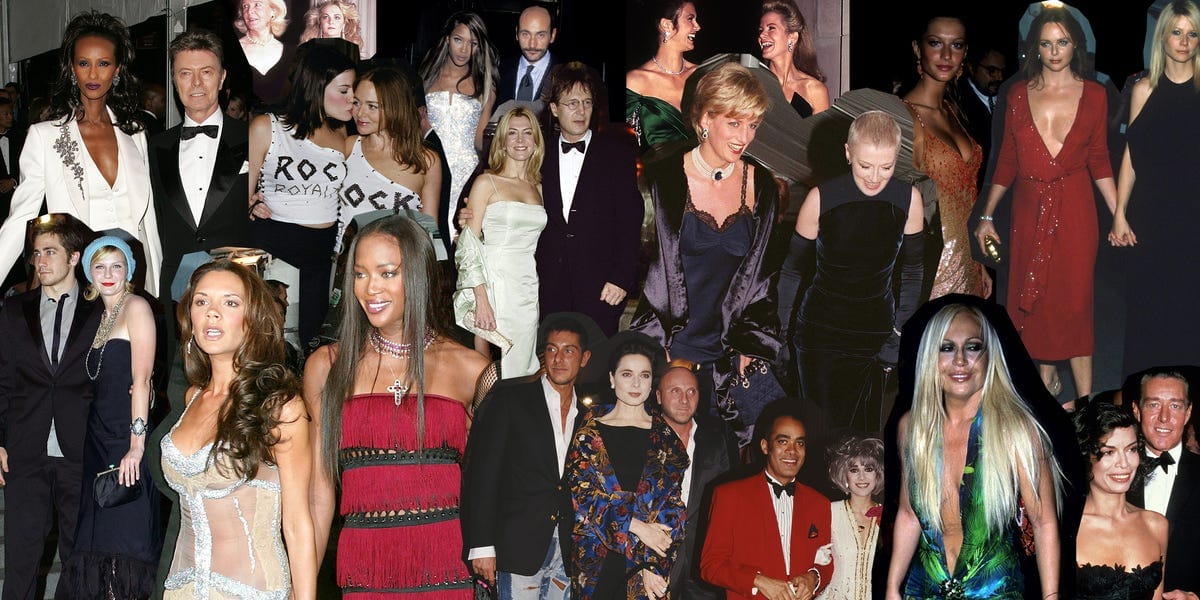
The Met Gala didn't invent itself overnight as the fashion world's most-watched spectacle. For decades, it existed as something far more intimate—a New York institution where designers mingled freely with photographers, where the after-party mattered more than the arrivals, and where you could actually smoke a cigarette on the marble floor without someone's publicist intervening. According to Harper's Bazaar, the shift from exclusive, behind-the-velvet-rope affair to global fashion theater happened in stages, accelerating when the internet arrived and the gala's May date change in 2001 coincided with the migration from film to digital photography.
Before the red carpet became a staging ground for TikTok moments, the gala was held in December, tucked inside the Met's main entrance. Photographers were literally cordoned off in a circle—a "fishbowl," as New York night life photographer Eric Weiss recalls—while guests slipped past or avoided the press altogether. Only Vogue's photographer and the Times' Bill Cunningham were permitted into the actual dinner. Once the seated event began, the press disbanded to file stories and develop film. The real action happened later: an intimate after-party at Temple Dendur where creative teams, designers, and photographers mingled without the anxiety of immediate digital distribution. People showed up in their own clothes. They actually relaxed.
When Fashion Was for New York, Not the World
Fashion designer Vera Wang, who has attended nearly every Met Gala since the late 1970s, remembers a fundamentally different beast. The crowd skewed Upper East Side—Brooke Astor, Mica Ertegun, society doyennes who treated the gala as a fundraiser and fashion showcase, not a performance. Dress codes were loosely enforced; Wang wore a Michael Kors parka with a slip dress and Native American jewelry to one event. The after-parties, held at the Met itself, functioned like actual clubs—dancing, music, people letting loose. There was glamour, yes, but it was intimate. "Things were smaller," Wang says. "The world wasn't as expansive."
The rupture came swift. When the gala moved to early May and photographers switched to digital, the intensity exploded. Suddenly there were hundreds of paparazzi, screaming crowds, and PR handlers blocking every frame. The after-parties became commercial enterprises or disappeared entirely. Security tightened. Access evaporated. What had been an evening where photographers cultivated relationships and earned trust transformed into a managed spectacle where you needed a publicist just to arrive. Mari Sarai, who shot the gala for a Spanish gossip magazine in 1998-99, remembers coordinating outfits with other paparazzi, scrapping for recognizable names, and the sheer chaos—photographers getting violent over a Claudia Schiffer moment.
The Met Gala didn't become a global phenomenon because the event got better or the fashion got bigger. It became one because social media made it impossible to keep exclusive anymore.
Read the original at Harper's Bazaar.