At Louis Vuitton Cruise, New York Meets Paris
Nicolas Ghesquière’s latest offering was inspired by the sights and sounds of the Big Apple.
Reported by Harper's Bazaar.
The weather at the Frick Museum on the Upper East Side could not have been more on-brand for New York: blinding summer sun when guests arrived, a flood-level downpour by the time they left. Nicolas Ghesquière made that volatility his thesis. For Louis Vuitton Cruise 2027, the designer built a collection around the push-pull between two cities — the house's Parisian DNA and the raw, kinetic energy of New York — and the result landed somewhere between uptown refinement and downtown nerve.
Graffiti, Primary Colors, and a Very Good Archive Find
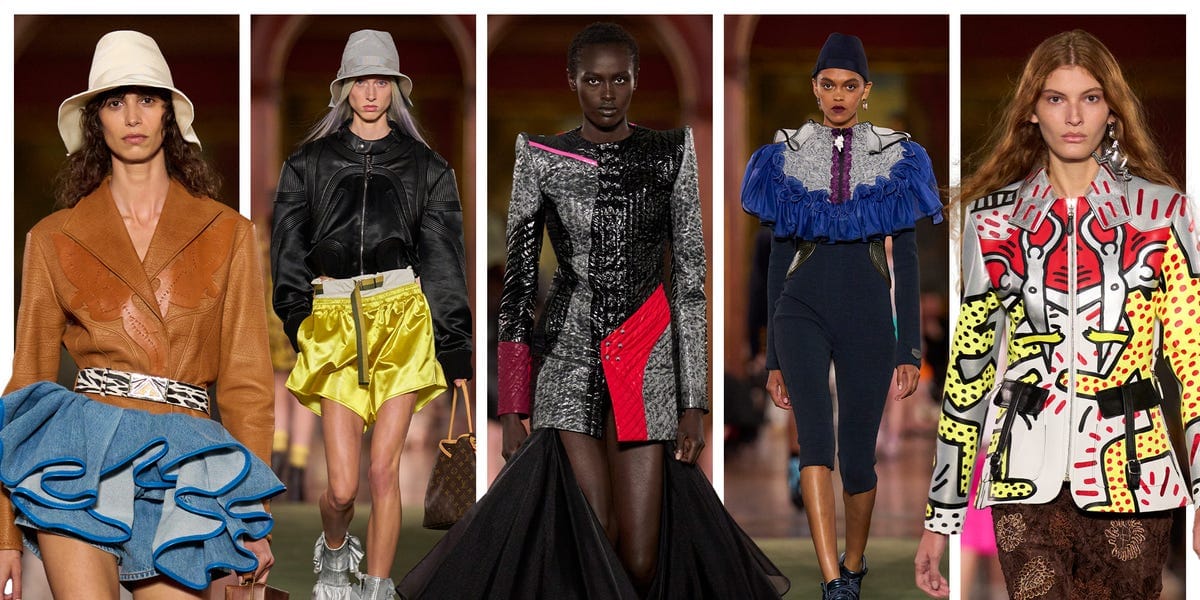
The uptown-downtown split wasn't just conceptual. According to Harper's Bazaar, Ghesquière anchored the show in a 1930 Louis Vuitton suitcase from the archive — one that had been graffiti'd by Keith Haring and apparently rediscovered by the designer — which opened the entire show as the first look's accessory. The Haring Foundation collaboration ran throughout: his signature linework appeared on jackets and swing tops as if the clothes themselves were canvases. Meanwhile, the Frick venue wasn't incidental — Louis Vuitton simultaneously announced a three-year cultural sponsorship with the institution, giving the whole evening a long-game quality that felt less like a stunt and more like a statement.
The collection moved to an electroclash set by Peaches, which was exactly the right call. Ghesquière pulled his palette from the street itself — taxi yellow, traffic-sign red, street-placard green — and ran it through oversized boxing shorts, capri pants, and both single- and double-breasted blazers worn with basketball sneakers. Jersey, denim, and leather did the heavy lifting as fabric choices: not precious, not trying too hard, just quintessentially American. Later looks softened into folded mini skirts, body-skimming capri bodysuits with ruffled hems, and brimless felt hats — Ghesquière's more signature register, but loosened up considerably.
What the collection captured, more than any single piece, was the specific freedom New York hands a person who pays attention to it. Ghesquière clearly does. The city's chaos doesn't destabilize this collection — it organizes it, gives it permission to be loud and precise at the same time.
When a designer stops treating a city as a backdrop and starts treating it as a collaborator, the clothes have somewhere real to live.
Read the original at Harper's Bazaar.