J.Crew CMO Julia Collier on Marketing Americana in Modern Times
As J.Crew continues its Camp Crew campaign rollout, the CMO talks to Vogue Business about striking the right chord in 2026.
Reported by Vogue.
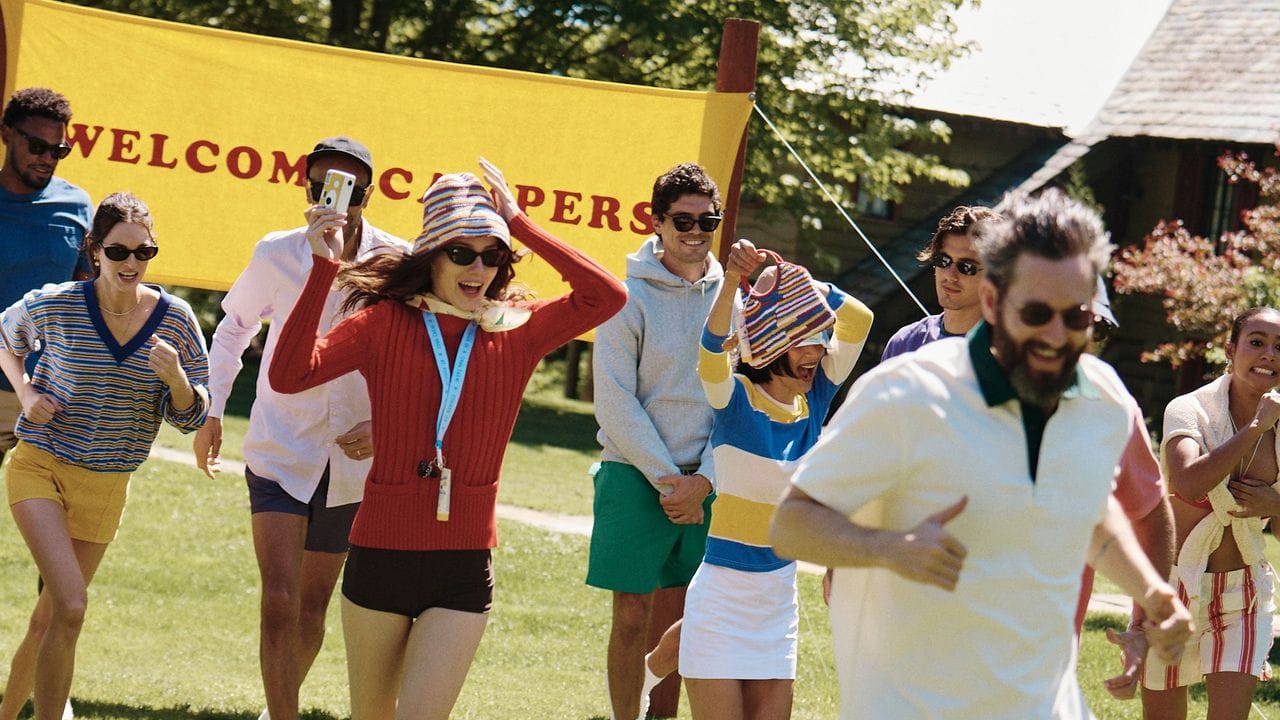
J.Crew CMO Julia Collier didn't attend Camp Crew. That's kind of the point. While creative director Terrence O'Connor, gallerist Hannah Traore, and actor Yesly Dimate spent two days canoeing, swimming off docks, and catching sunset boat rides in New York's Adirondacks, Collier stayed home — micromanaging from afar, by her own admission. The deliberate absence, she explains, is what makes it work. No official brand presence means guests actually connect, which is exactly what happened on J.Crew's Italy trip last summer. The brand trip as a format isn't new. Doing it without the CMO hovering nearby, obsessing over every shot? That's the edit.
Camp Crew is the centerpiece of a broader campaign built around the United States' 250th anniversary — though Collier, British-born and careful with language, is measured about how closely J.Crew aligns with the milestone. "We are an American brand and we're very proud of that," she told Vogue, adding that what J.Crew represents is a distinctly nostalgic slice of America. The campaign spans a limited-edition capsule collection, pop-up activations in Chicago, Georgetown, New Jersey, and Nashville, and a shoot featuring five 2010s Victoria's Secret Angels — Jasmine Tookes, Josephine Skriver, Martha Hunt, Sara Sampaio, and Taylor Hill — reunited in a summer camp setting that reads simultaneously retro and current. The cut of the bikini gives it away: this isn't an archive pull.
The Nostalgia Problem (and the Solution)
Collier joined J.Crew at the start of 2025, arriving from five years at Skims — four as SVP of brand marketing — and stepping into a brand that had clawed its way back from a 2020 bankruptcy filing under CEO Libby Wadle. The cultural rehabilitation was already underway; her job is to sustain the momentum in a far more crowded market. Gap and Abercrombie are both resurgent, Zara keeps pushing upmarket, and everyone is running campaigns with serious talent and serious budgets. Collier's strategy hinges on one thing J.Crew has that most competitors don't: a deep, emotionally resonant archive that consumers are already nostalgic for. She knows this because she reads the Reddit threads. Users on those forums pine for OG Cece flats and original pullover anoraks the same way they mourn old catalogs — a fact that partly explains why the @lostjcrew Instagram account, which resurfaces vintage J.Crew imagery, has developed a devoted following. But nostalgia deployed lazily becomes a liability. Her framing: it's not about the past, it's about the emotion attached to it — comfort, reliability, something universally human.
On the talent and collaboration side, she's running two parallel tracks. Figures like Molly Gordon and Benito Skinner bring J.Crew into the present tense for younger audiences, while reunion moments — like the Angels campaign — generate the kind of cultural conversation that pure newness can't manufacture. Collabs with independent designers like Maryam Nassir Zadeh and Christopher John Rogers court the fashion-literate consumer; partnerships with entities like US Ski & Snowboard generate mass hype through character-driven storytelling. The brand trips, meanwhile, stay intentionally small and niche — creative-community attendees whose influence runs deeper than follower count. "My goal is never to alienate our existing audience," Collier says. "But with these activations, it's really about acquisition."
As for selling Americana in 2026, when the concept is politically charged and culturally contested, Collier keeps returning to optimism — specifically the particular brand of it that, as an Englishwoman, she still projects onto the United States. The discipline, she argues, is in knowing when to stop talking. "If you try to say too much, you're not saying anything at all." In a media landscape drowning in brand messaging, restraint is the flex.
When nostalgia is your brand equity, the whole game is knowing exactly how much of it to spend.
Read the original at Vogue.