Marilyn Monroe on the Catwalk: How Designers Have Referenced the Blond Bombshell
Fashion was as important as costume in making an icon of Marilyn Monroe. Here, we take a look at how designers have referenced her face, silhouette, and performances in their collections.
Reported by Vogue.
A hundred years after her birth, Marilyn Monroe remains fashion's most reliably magnetic obsession. Not because designers are nostalgic — but because her image, her mythology, and the very tension between the woman and the icon still generate heat that translates directly to a runway. According to Vogue, an AI analysis of Monroe's defining characteristics flagged her face and hair first — which tracks, given how relentlessly both have been looted for collections across six decades.
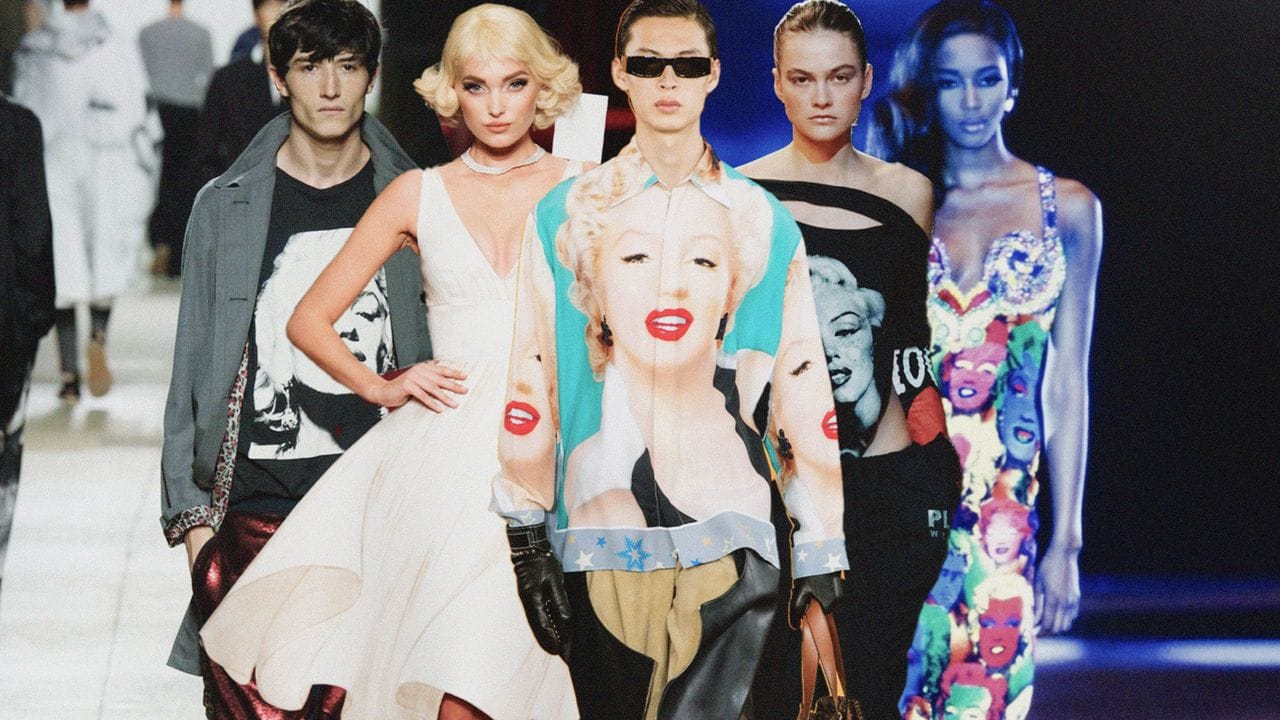
The most literal borrowers went straight for the portrait. Gianni Versace printed her face across a 1990 collection — work Donatella revived in 2017 when she pulled directly from the house archives. Dries Van Noten, better known for botanical prints than pop iconography, blew Monroe across T-shirts, button-ups, and boxing shorts for a menswear collection about creative provocateurs. Comme des Garçons Shirt partnered with the Andy Warhol Foundation to work his Monroe silkscreens into graphic Oxford shirts, paired with Monroe's own words: "Dogs don't bite me. Just humans." Dolce & Gabbana have referenced her in at least three collections — most sharply in their spring 1992 show, which recalled the potato-sack dress Monroe wore as a pointed response to critics who called her unstylish.
The Myth, Reengineered
Other designers have been more interested in Monroe's aesthetic DNA than her face. Thierry Mugler and Alexander McQueen both reworked her stage costumes — the white flyaway dress from The Seven Year Itch, the polished glamour of Gentlemen Prefer Blondes. McQueen's fall 2005 collection read, as critic Sarah Mower wrote at the time, like a director's cut — biker molls and sweater girls filtered through a sixties lens. Jean Paul Gaultier took the most abstract route: his 1984 cone bras, pre-Madonna, exaggerated the '50s silhouette Monroe weaponized into something almost cartoonishly surreal. Prabal Gurung used her for spring 2014 as a starting point for "the elegant woman" in a modern context, referencing her final photo session with Bert Stern. Max Mara went for the George Barris beach photographs from 1962 — Monroe at her most unguarded — as the entire mood for a fall collection.
What makes Monroe so durable as a reference isn't sentimentality — it's versatility. She can anchor a revenge narrative, a sex-positive provocation, a meditation on glamour and mortality, or a maximalist fantasy. Marc Jacobs saw her subway-grate dress in his own collection alongside Minnie Mouse and Disney gowns — "joy, period," as he put it. Christopher Kane coded her into kitten prints and boudoir negligees. A recent Vogue runway report noted that when a house needed to communicate something about platinum wigs, bullet bras, and cinematic femininity, Monroe was the shorthand that made everything click immediately.
Fashion keeps returning to Marilyn Monroe not because she's a safe icon, but because she's a loaded one — and a hundred years in, nobody's emptied the gun.
Read the original at Vogue.