The Artist Who Made the New York City Sanitation Department Her Inspiration
Maintenance Artist, a new documentary on Mierles Laderman Ukeles, is a must-watch.
Reported by Harper's Bazaar.
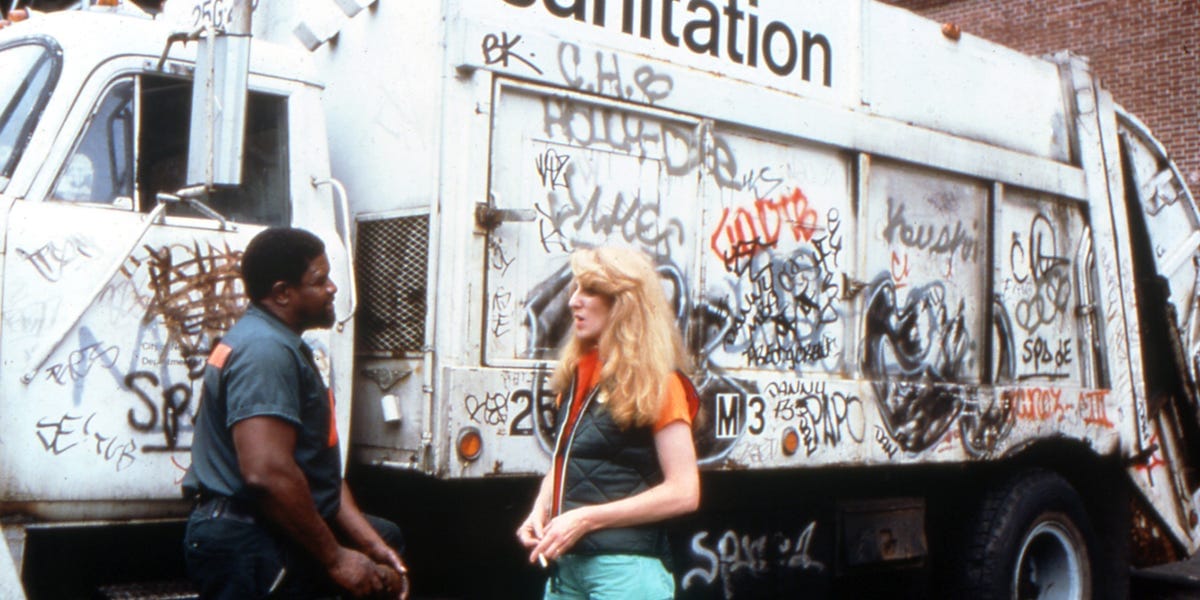
In 1984, artist Mierle Laderman Ukeles — wearing her signature green jumpsuit — stood inside a New York City landfill and shook hands with sanitation workers. Not as a stunt. Not as commentary. As the official, unsalaried artist-in-residence of the NYC Department of Sanitation, she was midway through Touch Sanitation, a performance piece that required her to personally thank all 8,500 sanitation workers across all five boroughs. One driver told her that 17 years earlier, a Brooklyn homeowner had ordered him and his crew off her porch, calling them "smelly garbage men." He looked at Ukeles and said: "Today you wiped that out." She still considers it the most meaningful moment of her career.
When Maintenance Became the Medium
Ukeles started out making abstract paintings and mixed-media work — until motherhood cracked her practice wide open. Changing diapers, doing laundry, running a household: none of it looked like what she'd been taught art was supposed to be. "I didn't see Jackson Pollock or Marcel Duchamp changing diapers," she's said. Rather than abandon her identity as an artist, she collapsed the distinction entirely. The result was her Maintenance Art Manifesto 1969! — a document of feminist conviction that invoked Duchamp's logic of naming to declare domestic labor, in all its unglamorous repetition, as art. The freedom-as-art philosophy traced back to her professor Robert Richenburg, the abstract expressionist who drilled into students at Pratt Institute that art is fundamentally about freedom — a lesson Ukeles kept long after the administration pushed her out for work they deemed too provocative.
From there, she performed maintenance tasks as art at the Wadsworth Athenaeum in 1973 (scrubbing steps, dusting display cases) and at the Whitney in 1976, where she asked 300 building maintenance workers to consciously designate one hour of their daily labor as art. A Village Voice review planted the seed for something bigger. She wrote directly to Sanitation Commissioner Anthony T. Vaccarello, and a phone call later, she had a position she'd hold for over 40 years, according to Harper's Bazaar.
The Department of Sanitation was, at the time, entirely male — which was precisely the point. Ukeles saw parallel dynamics at work: women managing invisible domestic labor at home, men managing invisible public labor on the streets, both groups dismissed, disrespected, and erased. Her feminist peers weren't always on board — some refused to acknowledge her collaboration with a male workforce as legitimate art at all. But Ukeles found solidarity with artists like Hannah Wilke and Ana Mendieta, who were also fighting for the right to make work rooted in the explicitly feminine. She also had pointed critiques of second-wave feminism itself, which she felt championed a narrow male model of professional success while leaving behind pink-collar workers, blue-collar workers, and — as she noted directly — many Black women who felt abandoned by the movement entirely.
All of this is documented in Maintenance Artist, a new documentary tracing her life and five-decade practice. What emerges is a portrait of an artist who understood, long before the culture caught up, that labor is political, dignity is radical, and art has the power to restore both. When the work lands — really lands — it doesn't hang on a wall. It looks a tired worker in the eye and says: I see you.
Ukeles built an entire artistic philosophy on the premise that staying alive, keeping going, and doing the unglamorous work of maintaining the world is not the opposite of freedom — it is, treated with intention, the very definition of it.
Read the original at Harper's Bazaar.