The Punk Lineage of Olivia Rodrigo’s Babydoll Dress
Women who rock have been wearing babydoll dresses and making people mad for decades
Reported by Harper's Bazaar.
The babydoll dress has never been innocent — and that's precisely the point. According to Harper's Bazaar, the silhouette traces back to 1940s lingerie designer Sylvia Pedlar, who created the ultra-short nightgown and matching bloomers as a practical response to wartime fabric rationing. Balenciaga and Givenchy eventually elevated the trapeze shape into couture, though they prudently lengthened the hem. By the 1960s, Jane Birkin, Twiggy, and Brigitte Bardot had reclaimed the short version as a uniform of sexual liberation, pairing Mary Quant and André Courrèges shifts with an attitude that read as radical defiance of the cinched, corseted decade before them.
From Kinderwhore to the Louvre
The dress got its sharpest edge in the 1990s, when female rockers — specifically Kat Bjelland of Babes in Toyland and Courtney Love, who developed the look as Portland roommates — turned frilly vintage finds into a subversive statement. The "kinderwhore" aesthetic, a term attributed to music journalist Everett True and Bjelland herself, weaponized the archetype of girlish fragility: pair a ruffled dress with torn stockings, bleached hair, and an electric guitar, and innocence becomes a provocation. Designer Anna Sui translated the energy directly into her Spring 1994 collection — babydoll dresses with white tights and combat boots — and Kim Gordon famously wore one of Sui's pieces in Sonic Youth's "Bull in the Heather" video, staring straight into the camera, fully in command of the joke.
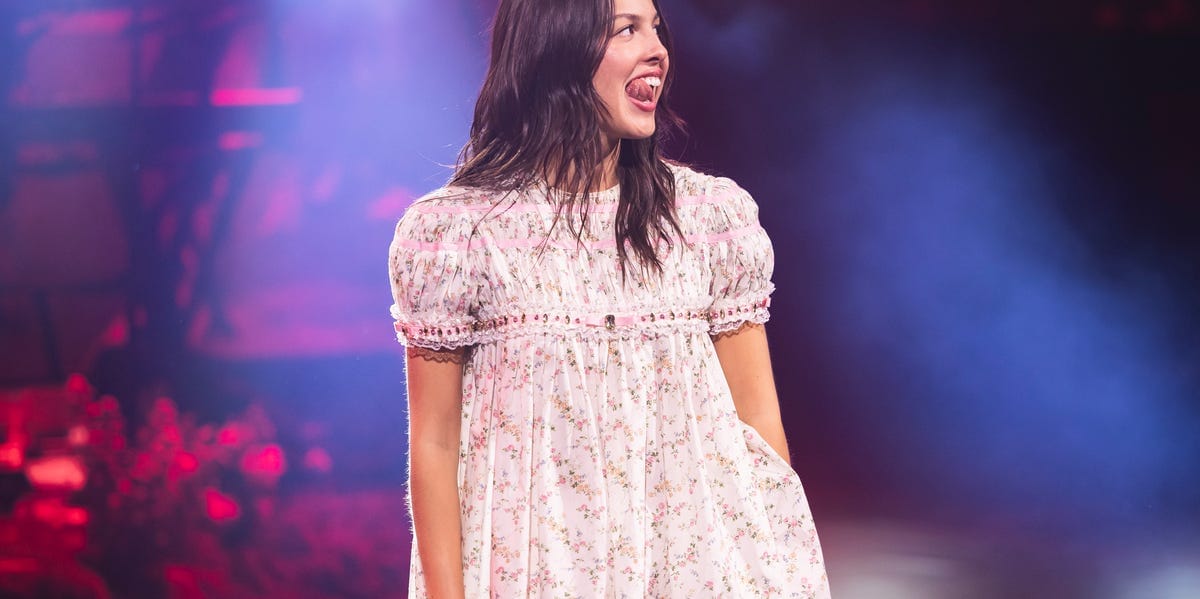
Olivia Rodrigo, now 23, grew up on this lineage. She's cited Bjelland and Love as direct style influences, and reportedly used a vinyl copy of Babes in Toyland's Fontanelle as an alarm clock. For her new album you seem pretty sad for a girl so in love, she's leaning fully into the silhouette — album cover in a pale pink Peter Pan collar mini, Mary Janes, and white socks; a Spotify performance in Barcelona in a Generation78 crystal-and-ribbon top with bloomer shorts and knee-high Doc Martens. Stylists Chloe and Chenelle Delgadillo describe drawing from Miu Miu and Marc Jacobs archives to build something "effortless, feminine, with a slightly undone feel." Rodrigo herself told British Vogue: "My Pinterest is all babydoll dresses and '70s necklines. I want it all to feel fun and laid-back."
Predictably, the internet found a way to make this about something it isn't. The Barcelona outfit became a flashpoint, with criticism framing Rodrigo's self-presentation as somehow inappropriate — the same reflexive moral panic that trails every young woman who graduated from a Disney property and dares to dress herself. The outfits in question are no more revealing than the plaid miniskirts and crop tops she wore during her Sour and Guts eras. Her audience — largely girls and young women — shows up to her concerts dressed in matching ruffles and combat boots, recognizing themselves in the look, not a male gaze.
Rodrigo addressed the noise directly during her 2023 SNL performance of "all-american bitch": babydoll dress on, knife in a heart-shaped cake, declaring "I know my age and I act like it." A silhouette with 80 years of feminist subtext doesn't suddenly lose its power because the internet gets nervous — if anything, that nervousness confirms it's still working.
Read the original at Harper's Bazaar.