When Did Red Carpet Fashion Get So Colorless?
A call for celebs to move beyond black and white, in Cannes and everywhere else
Reported by Harper's Bazaar.
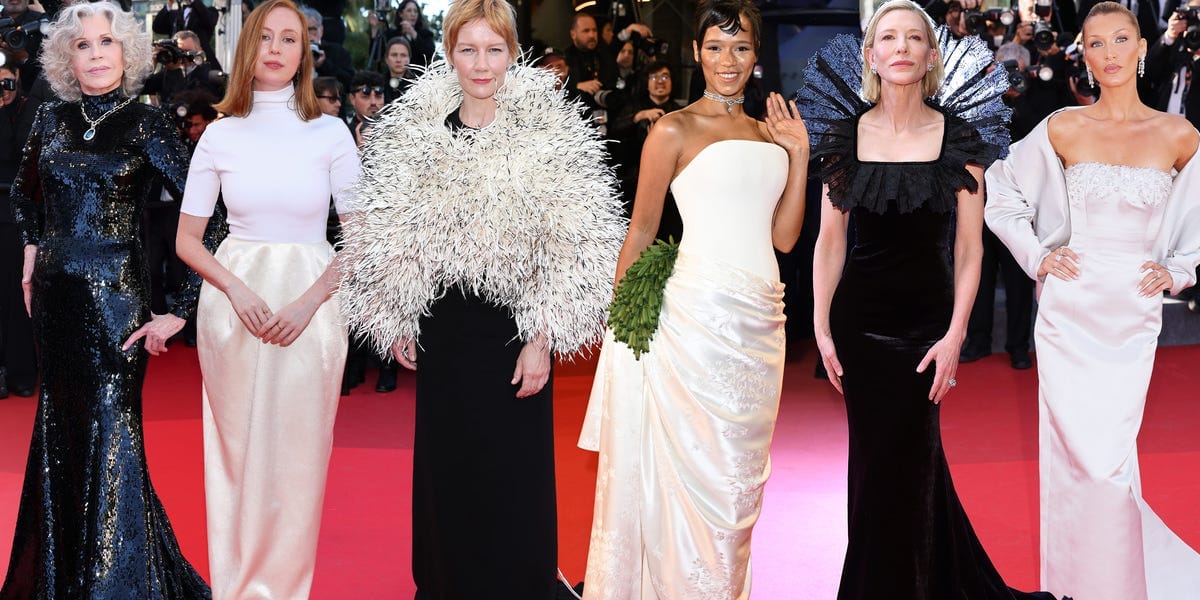
Something has gone quietly wrong on the red carpet. Not a scandal, not a misstep — just a slow, collective retreat into the safest corner of the color wheel. Black. White. Repeat. According to Harper's Bazaar, this phenomenon isn't confined to a single event: from the Golden Globes to the Oscars to this year's Met Gala — theoretically fashion's most maximalist night out — the biggest stars in the world have been showing up draped in grayscale, as if color itself has become controversial.
Cannes 2026 crystallized the trend. Bella Hadid, the festival's unofficial provocateur — the woman who once scandalized the Croisette in a thigh-high Alexandre Vauthier slit and later showed up in a keffiyeh dress as political statement — walked the premiere of Garance in custom Prada: a silvery-white strapless sheath, a coordinating jacket slipping off her shoulders, Chopard diamonds catching the light. Immaculate. Also: completely predictable. Meanwhile, Taylor Russell wore Dior white, Cate Blanchett did custom black Louis Vuitton, Ruth Negga went creamy slip, and Dua Lipa arrived in black-on-black Jacquemus. Even the reliably chaotic Met Gala delivered Kylie Jenner in cream Schiaparelli, Kendall Jenner in ivory Gap Studio, and Gigi Hadid in a metallic-black Miu Miu sheath. The peacocks stayed home.
The Cultural Logic of Playing It Safe
The trend has roots. Pantone named "Cloud Dancer" — a soft, barely-there off-white — its color of 2026, calling it "a conscious statement of simplification." That tracks with the broader cultural moment: Quiet Luxury bleeding into Carolyn Bessette-Kennedy minimalism, Love Story making the all-black New York uniform aspirational again, and the internet rewarding elevated basics with the kind of engagement that actually moves product. Matthieu Blazy closed his Fall 2026 Chanel show with a black trouser suit and a black jersey dress — a deliberate pivot from the multicolored, feathered finale of his debut season. It's worth noting that this October marks 100 years since Coco Chanel first introduced the little black dress. In 1926, the LBD was radical for being practical. In 2026, it's radical for being the only thing anyone seems willing to wear.
Social media is doing a lot of work here. Every red carpet choice now lives or dies by its comment section, especially when the event is broadcast globally and bankrolled by tech money. Black and white absorb criticism differently than color does — they read as "timeless," as "classic," as beyond reproach. Color, on the other hand, is emotional and therefore polarizing. It invites a reaction, and not everyone wants to be a reaction right now.
But here's what the grayscale parade keeps glossing over: the looks that have actually stayed with us this season are all chromatic. Jessie Buckley's baby-pink-and-red colorblocked Chanel at the Oscars looked like joy made textile. Wunmi Mosaku's cobalt blue fringe at the BAFTAs radiated authority. And Demi Moore in neon pink Matières Fécales at Cannes this weekend was physically impossible to ignore — the kind of entrance you can feel before you fully process it. These aren't just dresses; they're arguments. Color isn't the absence of sophistication — it's the presence of nerve, and right now, nerve is in short supply.
In a season that keeps rewarding restraint, the most daring thing a woman can do on a red carpet might simply be to wear something in an actual color.
Read the original at Harper's Bazaar.