Which Brand Will Win the World Cup?
The planet’s most globally viewed sporting event is approaching. Opportunities are rife, but nailing the delivery requires global, local, digital, and physical nous.
Reported by Vogue.
The World Cup has always been a commercial battleground, but the 2026 edition — broadcast across the US, Canada, and Mexico, with 48 national teams and an audience that reached five billion people across all media in 2022 — is shaping up to be something closer to a full-scale cultural takeover. According to Vogue, brands have been planning for this moment for years, and the strategies they're deploying go well beyond slapping a crest on a jersey.
Adidas reportedly dropped approximately $67 million on its hero campaign film Backyard Legends, which pulled 5.4 million TikTok views and 4.7 million YouTube views within its first two weeks. Chief creative officer Alasdhair Willis credits early groundwork — including last year's Trionda ball and kit launches — for giving the brand confidence heading into 2026. Nike, meanwhile, is leaning into its competitive DNA with a campaign featuring Zlatan Ibrahimović and Eric Cantona, while also rolling out collaborations with Palace, Jacquemus, and Patta tied to England, France, and the Netherlands respectively. The unspoken arms race between the two giants — Adidas dressing 22 national teams, Nike outfitting 16 — may be the most interesting rivalry of the tournament that isn't played on a pitch.
Style Is the New Sport
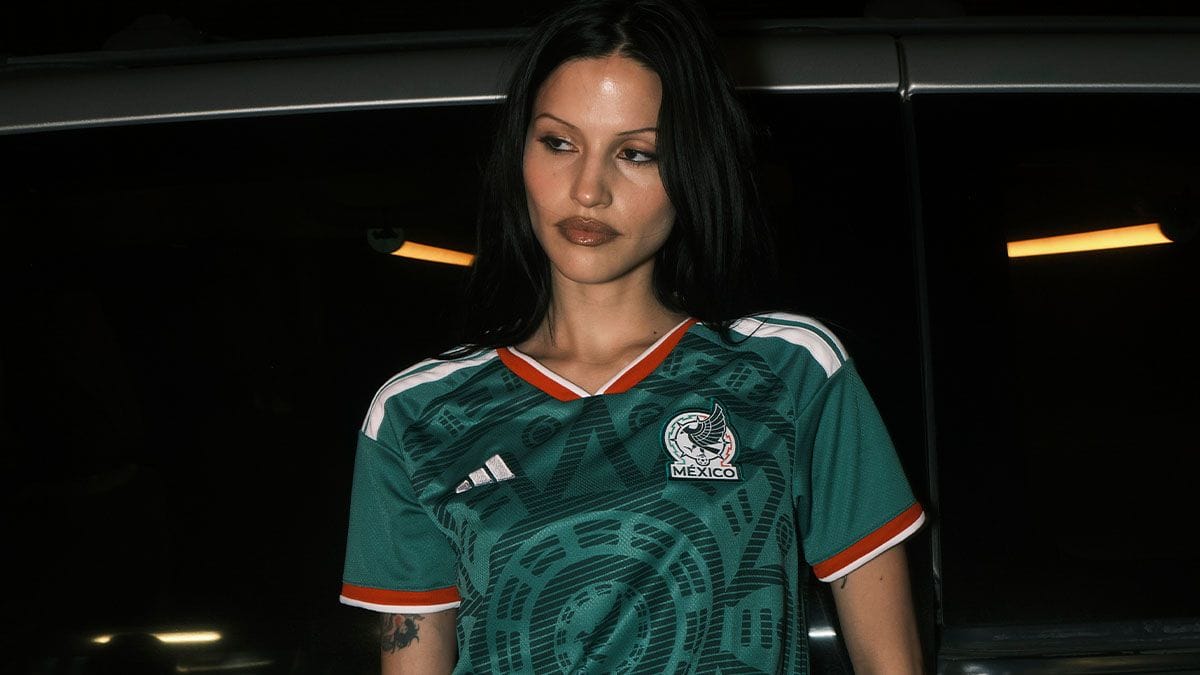
Off the pitch is where things get genuinely interesting for fashion. Tunnel walks have become a luxury placement goldmine: Kylian Mbappé fronted Jonathan Anderson's Dior summer 2026 campaign, while Jude Bellingham has been a Louis Vuitton ambassador since 2024. "When a luxury house aligns a piece with a player's pre-game fit, it's a masterclass in relevance," says Keenan Thomas, national account manager at youth culture agency Archrival. Levi's took a more grassroots angle, launching team denim capsules for Mexico, England, the US, and France — each shot with local creatives, from Mexico City label Tony Delfino to London vintage specialist 194 Local — while also serving as an official host for six matches at its namesake Bay Area stadium. On Pinterest, searches for "World Cup shirts" are up 840% year-on-year, with style queries like "Brazil shirt outfit women" up 302%, signaling, as Pinterest's Sophie Marlow puts it, that this is "as much a style moment as a sporting one."
The female audience factor is no longer a footnote. TikTok data shows that 46% of global sports views in the first half of 2025 came from women — a shift that brands like Gucci and Calvin Klein began anticipating years ago by signing players like Leah Williamson, Alessia Russo, and Alex Morgan. GWI senior data journalist Chris Beer notes that Mexico is a saturated market (eight in 10 consumers follow the sport), while the US and Canada represent the real growth frontier. Archrival's Peter Kalmbach adds that World Cup viewership has climbed continuously since 2006, and Asian markets — particularly India and China — are the next major frontier, even if harder to crack.
There's a real tension underneath all of this momentum, though. Cheapest final tickets cleared $4,030, and backlash to perceived excess is loud — Kalmbach points to the recent Met Gala as proof that audiences are increasingly allergic to overt wealth signaling. For brands, the lesson is that scale alone won't cut it: the winners of this particular tournament will be the ones who make a five-billion-person moment feel, somehow, personal.
Read the original at Vogue.